A small company in India can handle employee grievances without an HR team by naming one owner, writing a one-page grievance policy, acknowledging every complaint in writing, investigating before deciding, giving the employee a genuine hearing, and closing with a written outcome and a route of appeal. Two things stop being optional as you grow: a POSH Internal Committee once you have ten employees, and a Grievance Redressal Committee once you have twenty workers under the Industrial Relations Code, in force since 21 November 2025.
Most of the advice online is written for another country
Search “how to handle a grievance without HR” and the top results talk about the ACAS Code of Practice, employment tribunals and the right to be accompanied by a trade union representative. That is United Kingdom law. None of it binds an Indian company, and following it will leave you compliant with the wrong statute.
In India the rules a small company answers to come from four places: the state Shops and Establishments Act that registered your office, the Sexual Harassment of Women at Workplace (Prevention, Prohibition and Redressal) Act, 2013, the Industrial Relations Code, 2020, and the principles of natural justice that Indian courts apply to any disciplinary decision. This guide is built on those four, not on a UK code.
The good news is that a founder can run a fair process without an HR department. What you cannot do is improvise it after the complaint arrives.
Three obligations arrive on a headcount ladder
Indian employment law switches on by headcount, not by whether you have hired an HR person. These are the rungs that matter for grievances.
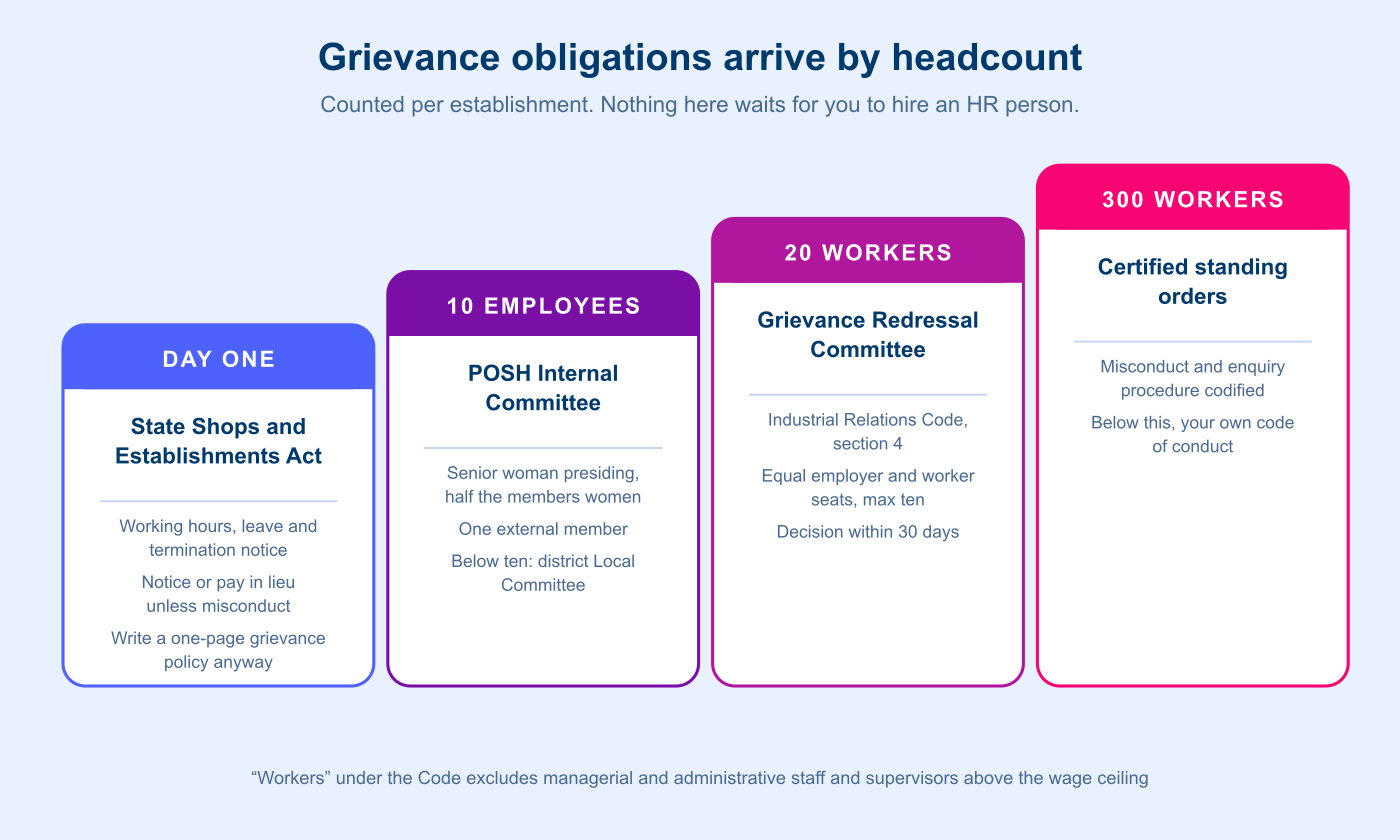
Day one. Your state Shops and Establishments Act governs working hours, leave and termination notice. Most state Acts bar dismissal of an employee past a qualifying period without notice or pay in lieu unless it is for misconduct; Karnataka’s is one example. A written grievance procedure is not mandated at this size, but every court and inspector will ask what your process was.
Ten employees. The POSH Act requires an Internal Committee at every workplace with ten or more employees. Below ten, complaints go to the district Local Committee. This is the single most common gap in startups, and the penalty for not constituting the committee runs to INR 50,000 for a first offence.
Twenty workers. Section 4 of the Industrial Relations Code requires one or more Grievance Redressal Committees in every industrial establishment employing twenty or more workers, with equal employer and worker representation, a maximum of ten members, and proportional representation for women. A grievance goes to the committee within one year of the cause, and the committee is expected to complete its proceedings within thirty days.
Three hundred workers. Certified standing orders, which codify misconduct and disciplinary procedure, become compulsory. Below this, you write your own code of conduct, and you should.
The word “workers” in the Code is narrower than “employees”. It excludes people in managerial or administrative roles and supervisors earning above INR 18,000 a month. A twenty-five person startup with twelve engineers and thirteen managers may not cross the rung; a support centre with twenty-two agents will. Count before you assume.
A grievance process a founder can run
The process below is what unHR sets up inside client companies in the first month. It is short on purpose. A one-page policy that is followed beats a twelve-page one nobody reads.
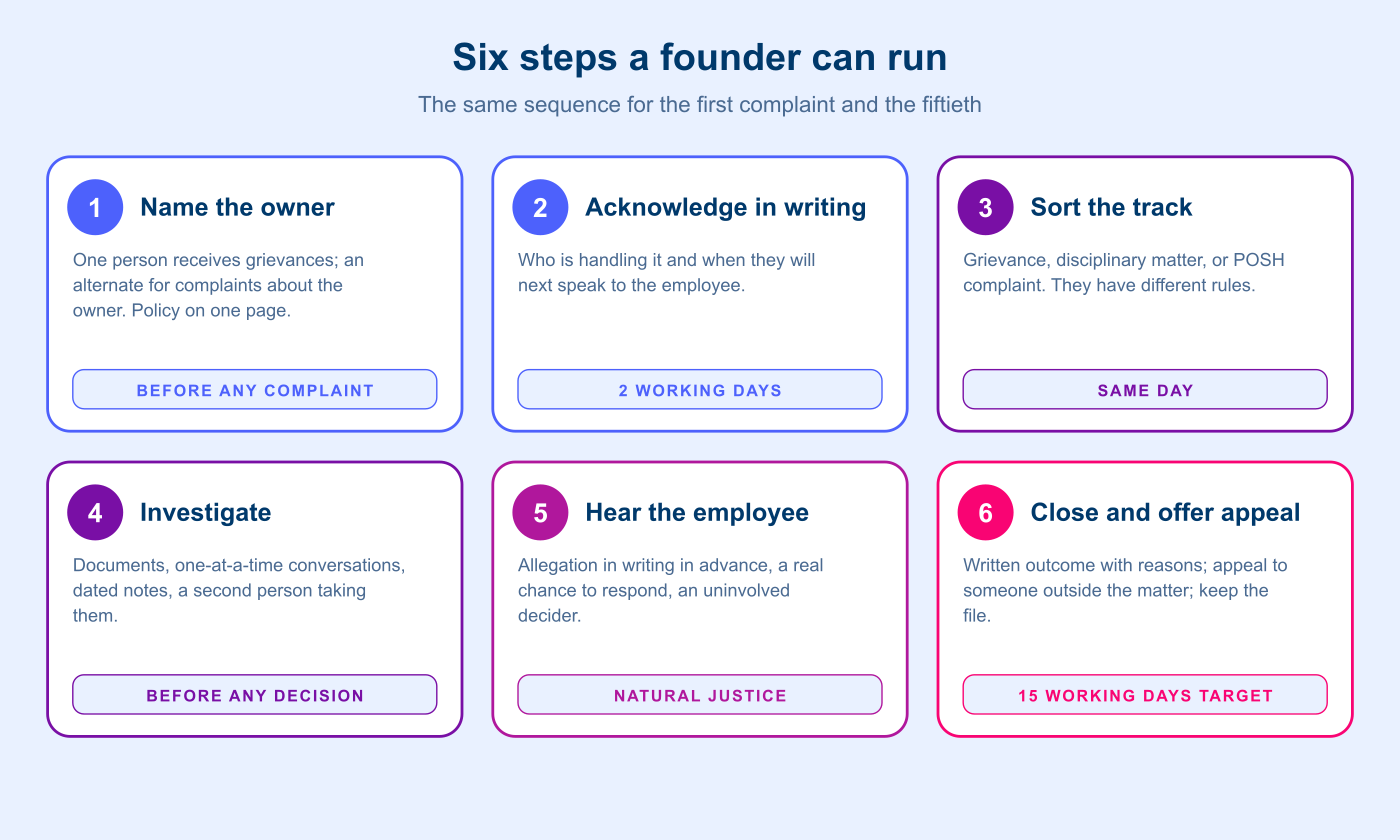
Name the owner and write the policy down
Pick one person who receives grievances. In a company with no HR that is usually a co-founder who does not manage most of the team day to day. Name an alternate for complaints about the owner. Then write the policy: who to write to, what happens next, how long each stage takes, and what the employee can do if they disagree with the outcome. Put it in the offer letter pack and the shared drive. A policy that exists only in the founder’s head does not exist.
Acknowledge in writing within two working days
No statute sets a clock for a general grievance in a small company; the Grievance Redressal Committee’s thirty days is the only statutory benchmark, and it applies from twenty workers. So set your own and publish it. Acknowledge within two working days, state who is handling it, and give a date for the next conversation. Most grievances that turn into labour department complaints do so because nobody replied, not because the answer was wrong.
Sort it into the right track before you act
There are three tracks and they have different rules. A grievance is an employee complaining about their treatment: pay, workload, a manager, a policy. A disciplinary matter is the company alleging misconduct by an employee. A sexual harassment complaint is neither, and goes to the Internal Committee under the POSH Act with its own timelines. Founders lose cases by treating a POSH complaint as an ordinary grievance, or by answering a grievance with a show-cause notice to the person who raised it. Decide the track first, in writing.
Investigate before you decide
Collect the documents, speak to the people involved one at a time, and keep dated notes of each conversation. Bring a second person to take notes so the person handling the grievance can listen. Keep the circle small: tell only those who need to know, and tell them it is confidential. Do not reach a conclusion, and do not signal one, until the facts are in.
Hold a hearing that follows natural justice
Indian courts test any adverse decision against the principles of natural justice, whether or not your company is large enough for standing orders. In practice that means four things. The employee knows, in writing and in advance, what the complaint or allegation is. They get a real chance to respond and to question the evidence. The person deciding has no stake in the outcome. And the outcome is a reasoned, written decision. The Model Standing Orders notified on 8 May 2026 allow a worker facing an enquiry to be represented by a trade union office-bearer or a co-worker of their choice; they bind only establishments with three hundred or more workers, but offering the same at any size costs nothing and reads as fair.
Close in writing and offer an appeal
Send the outcome in writing with the reasons and what will change. State a route of appeal to someone who was not involved: the other co-founder, a board member, or an external HR advisor if the company is too small for either. Keep the complete file, acknowledgement to outcome, for at least as long as the employee is with you and the limitation period after. If the matter ever reaches a conciliation officer or a labour court, that file is your case.
The three tracks side by side
Use this to decide the track in step three. The columns are the questions a founder actually needs answered.
| Track | Who raises it | Who handles it | Statutory clock | How it closes |
|---|---|---|---|---|
| General grievance | An employee, about pay, workload, a manager, conduct of a colleague or a policy | The named grievance owner; a Grievance Redressal Committee once you employ twenty or more workers | None below twenty workers; the committee has thirty days and the grievance must be raised within one year | Written outcome with reasons; appeal to an uninvolved person; conciliation officer, through a union, if unresolved |
| Sexual harassment complaint | An aggrieved woman, or someone on her behalf, under the POSH Act | The Internal Committee at ten or more employees; the district Local Committee below ten | Complaint within three months of the incident, extendable by three; inquiry completed within ninety days; report within ten days; employer acts within sixty days | Committee report with recommendations; employer implements; annual report to the District Officer; criminal complaint is the complainant’s separate right |
| Disciplinary action | The company, alleging misconduct by an employee | An enquiry officer with no stake in the outcome; the decision-maker separately | None in most startups; notice or pay in lieu under the state Shops and Establishments Act unless dismissal is for proven misconduct | Show-cause notice, enquiry, reasoned written order; appeal under the state Act where it provides one |
When it is sexual harassment, the process is not yours to design
The POSH Act is a standalone statute; the labour codes did not absorb it. It tells you who sits on the committee, how long each stage may take and what happens to the report. A founder handling a sexual harassment complaint personally, however sympathetically, is outside the law.
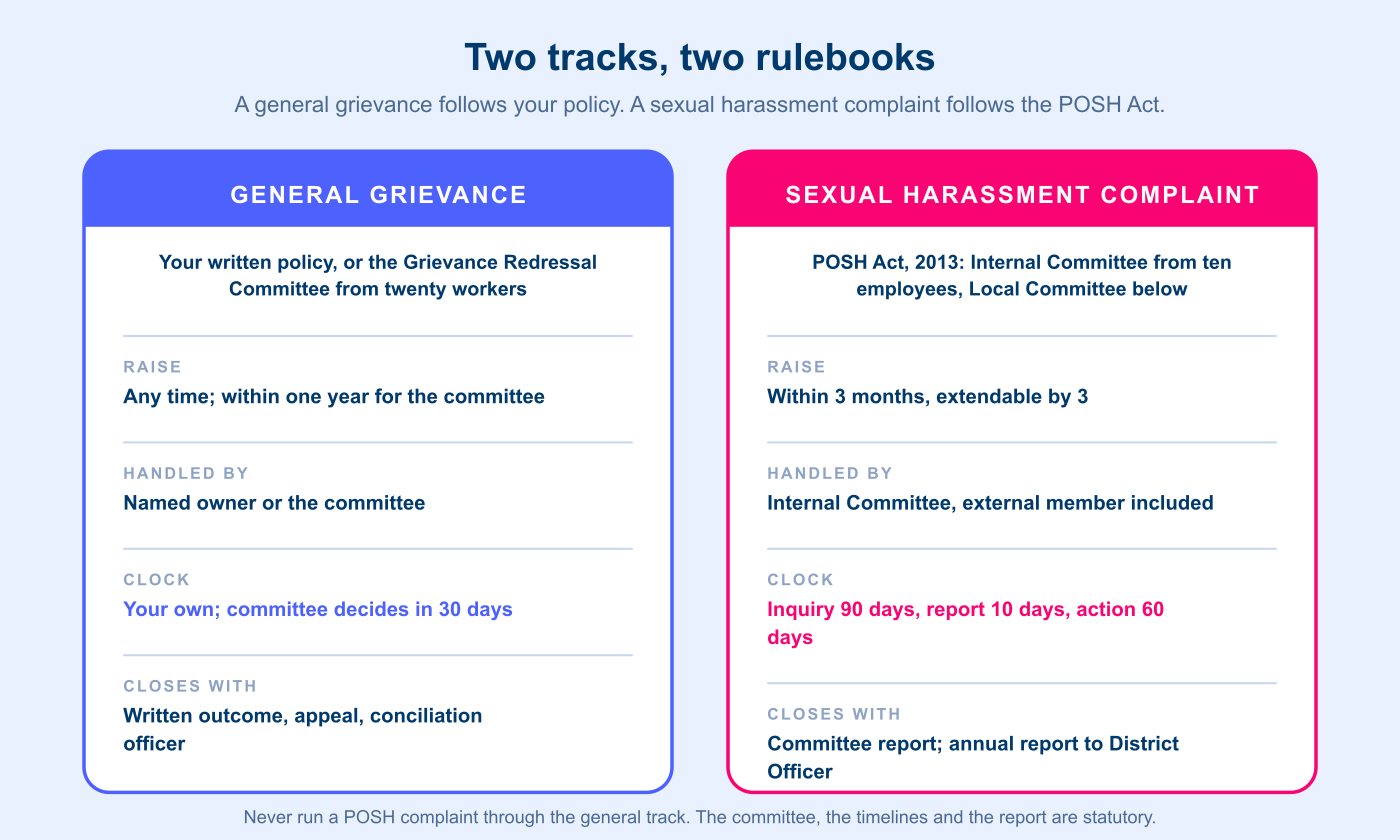
The Internal Committee needs a presiding officer who is a senior woman employee, at least two members from among employees, and one external member from an NGO or a person familiar with sexual harassment issues; at least half the members must be women. Companies below ten employees do not form one; complaints go to the Local Committee constituted by the District Officer. Once a complaint is filed, the committee has ninety days to complete the inquiry, ten days after that to deliver its report, and the employer has sixty days to act on the recommendations. Every company with a committee files an annual report with the District Officer.
Two practical points for small companies. First, the external member is the one you can arrange today, before any complaint exists; unHR maintains a panel for client companies. Second, sexual harassment is also an offence under Section 75 of the Bharatiya Nyaya Sanhita, and a complainant may go to the police regardless of what your committee does. Your process runs alongside that, never instead of it.
Discipline and exits without an HR team
The mirror image of a grievance is the company’s own complaint against an employee, and this is where small companies get sued. Indian courts have set aside dismissals for decades on the ground that the enquiry was unfair, even when the misconduct was real; the Supreme Court’s five-point test in Sur Enamel dates from 1963. The sequence courts expect is a show-cause notice or charge sheet setting out the allegation, an enquiry conducted by someone other than the complainant, a chance for the employee to respond and question witnesses, and a reasoned order that follows from the findings.
Termination is also regulated by the state Act your office is registered under. In Karnataka, an employee with six months of continuous service cannot be removed without a reasonable cause and one month’s notice or wages in lieu, unless misconduct is proved at an enquiry, and the employee may appeal to the Assistant Commissioner of Labour within thirty days. Delhi’s Act carries a similar one-month rule after three months of service, but it was amended in 2026 to cover only establishments with twenty or more employees, so a smaller Delhi startup should check whether the amendment is in force for its office. Check your own state before you act; the numbers differ, the principle does not.
One rule covers most of the risk: never take an adverse step against an employee in the weeks after they raise a grievance or a POSH complaint without a documented reason that predates the complaint. Courts read the timing.
Mistakes small Indian companies make
Treating a POSH complaint as an ordinary grievance. The committee, the timelines and the report are statutory. A founder-run conversation does not discharge them.
One person as investigator, judge and appeal. In a five-person company it may be unavoidable at the first stage, which is why the appeal must go outside: a board member, an advisor or an embedded HR partner.
Records on WhatsApp only. Chats are evidence, but they are not a file. Keep the acknowledgement, notes, hearing record and outcome as dated documents in one place.
Silence. The most common route to a labour department complaint is a grievance that was never acknowledged.
Not counting workers. Founders assume the twenty-worker committee requirement is for factories. The Code’s definition of industrial establishment is wide; count your non-managerial headcount and check.
Skipping the Internal Committee because “we are all friends”. The Act does not have a culture exemption, and the penalty applies whether or not a complaint was ever made.
Acting on the day of the complaint. Suspending, transferring or cutting the pay of the person who complained, before any enquiry, is the pattern courts treat as retaliation.
When to bring in outside help
Some matters are beyond a founder-run process at any size. A complaint against a co-founder or the grievance owner. Any allegation of sexual harassment, caste or religious discrimination, or harassment on the basis of disability or pregnancy. An employee who has written to the labour commissioner or a conciliation officer. A grievance from a group rather than an individual. A company whose people sit in more than one state, where the Shops and Establishments rules differ office by office, which our Delhi NCR guide covers in detail.
In each of these, the cost of getting the process wrong is larger than the cost of an afternoon with someone who has run it before.
What an embedded HR manager does about this
Most startups do not need a full-time HR hire to run grievances well. They need the policy written, the committees constituted, one trained person to run the process, and somewhere for the records to live. That is what unHR’s embedded HR manager does in the first month: a grievance policy and code of conduct in your name, an Internal Committee with an external member from our panel, a Grievance Redressal Committee if your worker count requires one, and the enquiry template so the first complaint is handled the same way as the fiftieth.
The Startup Pack is INR 40,000 a month with no lock-in, which is less than a single badly handled exit tends to cost. Records move out of chat threads and into an HRMS; our guide to choosing between payroll software and an HRMS explains what to look for. If you have a complaint on your desk right now, talk to us today. Our guide to fractional HR in India compares that option with a full-time hire in rupees.
Frequently asked questions
Is a small company in India legally required to have a grievance procedure?
Not by a single statute at every size. The Industrial Relations Code requires a Grievance Redressal Committee in industrial establishments with twenty or more workers, and the POSH Act requires an Internal Committee at ten or more employees for sexual harassment complaints. Below those thresholds there is no mandated procedure, but any dismissal or adverse action will be tested against the principles of natural justice and the notice rules in your state Shops and Establishments Act, so a written process protects you from day one.
How quickly must an employer respond to an employee grievance in India?
For a general grievance in a company below twenty workers, no statute sets a deadline. The Grievance Redressal Committee, mandatory from twenty workers, must complete its proceedings within thirty days. Sexual harassment complaints have fixed clocks under the POSH Act: the inquiry must be completed within ninety days, the report delivered within ten days after that, and the employer must act within sixty days. A practical standard for small companies is to acknowledge within two working days and close within fifteen.
Does a startup with fewer than ten employees need a POSH committee?
No. The Internal Committee is required at workplaces with ten or more employees. Below ten, complaints of sexual harassment go to the Local Committee constituted by the District Officer for the district. The employer’s other duties under the Act, including a safe working environment and displaying the penal consequences of sexual harassment, still apply.
Can an employee bring a colleague to a grievance or disciplinary meeting in India?
There is no general statutory right for every employee, unlike in the United Kingdom. The Model Standing Orders notified on 8 May 2026 allow a worker facing an enquiry to be represented by a trade union office-bearer or a co-worker of their choice, but they bind only establishments with three hundred or more workers. Courts treat refusing a reasonable request for representation as a natural justice defect. For a small company the safe practice is to allow a colleague to accompany the employee in any formal hearing.
What changed for grievances under the labour codes in force since 21 November 2025?
The Industrial Relations Code replaced the Industrial Disputes Act and the Standing Orders Act. The Grievance Redressal Committee is now required at twenty or more workers with a thirty-day decision window and a one-year limit for raising a grievance, and a worker unhappy with the decision may take it to the conciliation officer, through a trade union, within sixty days. Standing orders now apply from three hundred workers rather than one hundred, so most startups write their own code of conduct. The POSH Act was not merged into any code and continues unchanged.
Sources
Ministry of Labour and Employment, the Industrial Relations Code, 2020 and the labour codes: labour.gov.in
The Sexual Harassment of Women at Workplace (Prevention, Prohibition and Redressal) Act, 2013, Ministry of Women and Child Development: wcd.gov.in
Delhi Shops and Establishments Act, 1954, Labour Department, Government of NCT of Delhi: labour.delhi.gov.in
Karnataka Shops and Commercial Establishments Act, 1961 and Rules, 1963, Department of Labour, Government of Karnataka: labour.karnataka.gov.in
Model Standing Orders, 2026, S.O. 2312(E), Ministry of Labour and Employment: labour.gov.in
Sur Enamel and Stamping Works v. Their Workmen, AIR 1963 SC 1914, and Workmen of Firestone Tyre v. Management, AIR 1973 SC 1227: indiankanoon.org
Bharatiya Nyaya Sanhita, 2023: indiacode.nic.in