Fractional HR in India means engaging an experienced HR manager for a fixed share of their time, typically 30 to 80 hours a month, instead of hiring one full time. The company gets a named person who runs onboarding, payroll inputs, PF and ESI filings, policies, appraisals, grievances and exits, at a monthly fee that starts around INR 40,000. It suits companies between roughly five and one hundred employees, where the HR work is real and statutory but does not fill a working month. A full-time HR manager in India costs about INR 80,000 a month once salary, employer provident fund and gratuity are counted, before the cost of hiring them.
The HR work arrives before the HR headcount does
An Indian startup with eight employees already has a compliance calendar. Provident fund and state insurance contributions are due by the 15th of the following month. Professional tax, where the state levies it, is due monthly or half-yearly. Offer letters, appointment letters and exit paperwork have to exist and match. From the tenth employee, a POSH Internal Committee becomes mandatory. From the twentieth, provident fund registration and a Grievance Redressal Committee follow. None of this waits for the company to hire someone whose job title says HR.
The founder usually absorbs it. Then a finance person absorbs it. Then a missed filing, a badly handled exit or an investor's due-diligence checklist makes the gap visible. The full-time hire that follows is often the wrong size: a mid-level generalist on a mid-level salary, with a workload that fills two weeks of a month.
Fractional HR exists for the gap between those two points. This guide sets out what the model is, how it works in the Indian regulatory context, what it costs against a full-time hire, which companies it fits, and how to choose a provider. Every figure is dated and sourced, because most of what ranks for this query is written for the United States and quotes dollar retainers that mean nothing in Bengaluru or Gurugram.
What fractional HR means, and what it is not
A fractional HR manager is an experienced HR professional whose time is split across a small number of client companies. Each client gets a fixed number of hours a month, a named person, and the processes and templates that person brings from having done the job before. The word fractional describes the time, not the seniority: the point is that a ten-person company gets someone with years of HR experience, which it could not afford or fully occupy on a full-time basis.
It is worth separating the model from four things it gets confused with, because the confusion drives bad purchasing decisions.
An HR consultant is engaged for a project: write the policy manual, set up the appraisal cycle, run a compensation benchmark. They deliver and leave. A fractional HR manager runs the function every month, including the parts that only happen when something goes wrong.
A staffing or PEO arrangement puts your employees on someone else's payroll. In India this is contract staffing under the Contract Labour Act and now the Occupational Safety, Health and Working Conditions Code. Your people stop being your employees. Fractional HR leaves employment where it is and manages it.
A recruitment agency fills roles for a fee per hire. Recruiting is one of the things an HR function does, and some fractional providers include sourcing support, but hiring alone is not HR.
Payroll software or an HRMS is a system. It computes PF and TDS, stores leave balances and generates payslips. Someone still has to configure it, feed it, chase the inputs and answer the employee who thinks their payslip is wrong. Our guide to choosing between payroll software and an HRMS covers the tooling; this guide covers the person.
The nearest honest description of fractional HR in the Indian market is a dedicated HR manager, employed and trained by a provider, placed with your company for a contracted number of hours a month, working inside your tools and reporting to you.
How fractional HR works in India
The engagement usually follows one of three shapes.
Monthly retainer for a fixed number of hours. The most common model for companies under 100 employees. Hours are tracked and visible to the client. The HR manager attends the weekly leadership meeting, works from the office on set days in cities where the provider has a presence, and is reachable in between.
Project engagement. A defined piece of work with a start and end: HRMS implementation, a policy set for a DPIIT-recognised startup, an appraisal cycle, a hiring sprint for a new office.
Interim cover. A full-time HR manager has resigned, is on maternity leave, or has not yet been hired. The fractional manager holds the function until the permanent person is in the chair, and hands over.
What sits inside the retainer is where Indian providers differ from the US-style fractional CHRO offering. In the US the pitch is strategic advice at executive level. In India, for the companies that actually buy this, the retainer has to carry the operational and statutory load first, because there is nobody else to carry it. A working month for an embedded HR manager at a 25-person company looks like this.
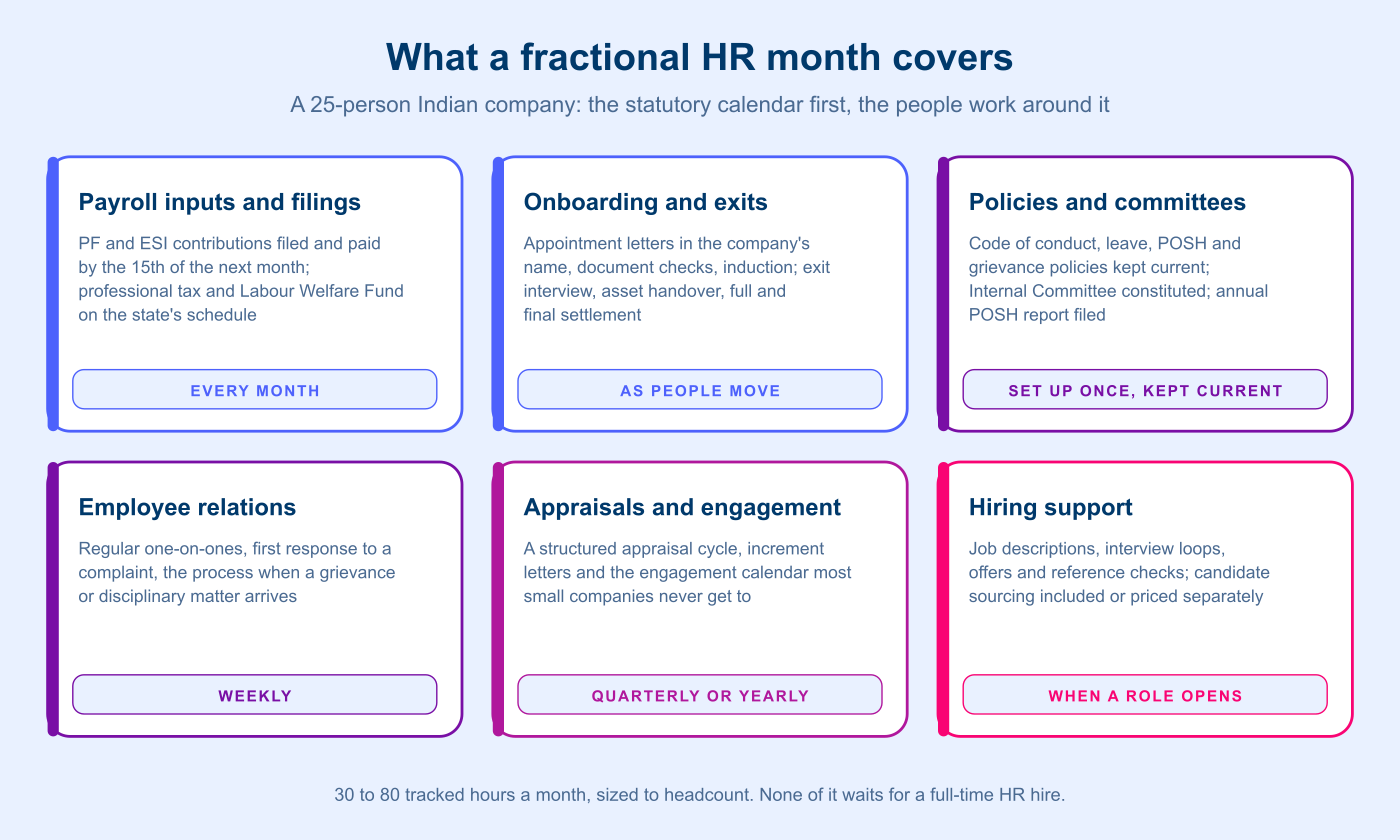
Payroll inputs and statutory filings. Attendance and leave reconciliation, new joiner and exit data to the payroll system, the employer's provident fund and ESI contributions filed and paid by the 15th of the following month, professional tax and Labour Welfare Fund on the state's own schedule.
Onboarding and exits. Offer and appointment letters in the company's name, document collection, background checks where the role warrants, induction, and at the other end the exit interview, asset handover, full and final settlement, and tracking of absconding cases.
Policies and committees. A code of conduct, leave policy, POSH policy and grievance policy that reflect the current law, an Internal Committee that is actually constituted rather than named on a poster, and the annual POSH report filed.
Employee relations. Regular one-on-ones, the first response to a complaint, and running the process when a grievance or disciplinary matter arrives. Our guide to handling employee grievances without an HR team describes that process in detail.
Appraisals and engagement. A structured appraisal cycle, increment letters, and the engagement calendar that most small companies intend to run and never do.
Hiring support. Job descriptions, interview loops, offer negotiation and reference checks, with candidate sourcing either included or priced separately depending on the plan.
The regulatory ground has moved, which is the argument for experience
The reason a small company benefits from an experienced HR person rather than a junior one is that Indian employment law has changed more in the last twelve months than in the previous twenty years, and it keeps changing.
The four labour codes came into force on 21 November 2025, replacing 29 central statutes, with the central rules notified on 8 May 2026. The Code on Wages caps excluded allowances at half of total remuneration, so provident fund and gratuity now compute on at least 50 percent of pay. Fixed-term employees earn gratuity after one year of service instead of five. Provident fund coverage under the Code on Social Security extends to every establishment with 20 or more employees, not only scheduled industries.
The EPFO wage ceiling rose from INR 15,000 to INR 25,000 a month, approved by the Union Cabinet on 16 September 2026 and effective from 17 September 2026, with the scheme amendments being notified as this guide was published. The government expects more than 51 lakh additional employees to come under mandatory coverage. For an employer the practical effect is that every employee with a basic wage up to INR 25,000 must now be enrolled, and the maximum mandatory employer outgo per employee moves from about INR 1,950 to about INR 3,250 a month.
State rules are notified on the state's own timeline. A company with people in Delhi, Gurugram and Noida answers to three state regimes for shops and establishments registration and Labour Welfare Fund. Delhi has amended its Shops and Establishments Act in 2026 to apply only to establishments with 20 or more employees. Karnataka, Maharashtra, Telangana and several other states levy professional tax; Delhi, Haryana and Uttar Pradesh do not. Our guide to HR consultants for startups in Delhi NCR works through the three-state problem.
POSH has not changed and has not gone away. The Sexual Harassment of Women at Workplace Act 2013 stands outside the codes. An Internal Committee is required at every workplace with ten or more employees, with a fine of up to INR 50,000 for not constituting one.
A founder can learn all of this. The question is whether that is the best use of a founder's month. A fractional HR manager who works across several companies sees each of these changes several times in the quarter it happens, and brings the updated template to your company with it.
Which companies fractional HR suits
India had 2,12,283 DPIIT-recognised startups as on 31 January 2026, and most of them will cross ten employees before they hire anyone for HR. The model fits a specific band of those companies, and it is more useful to describe the band than to claim it fits everyone.
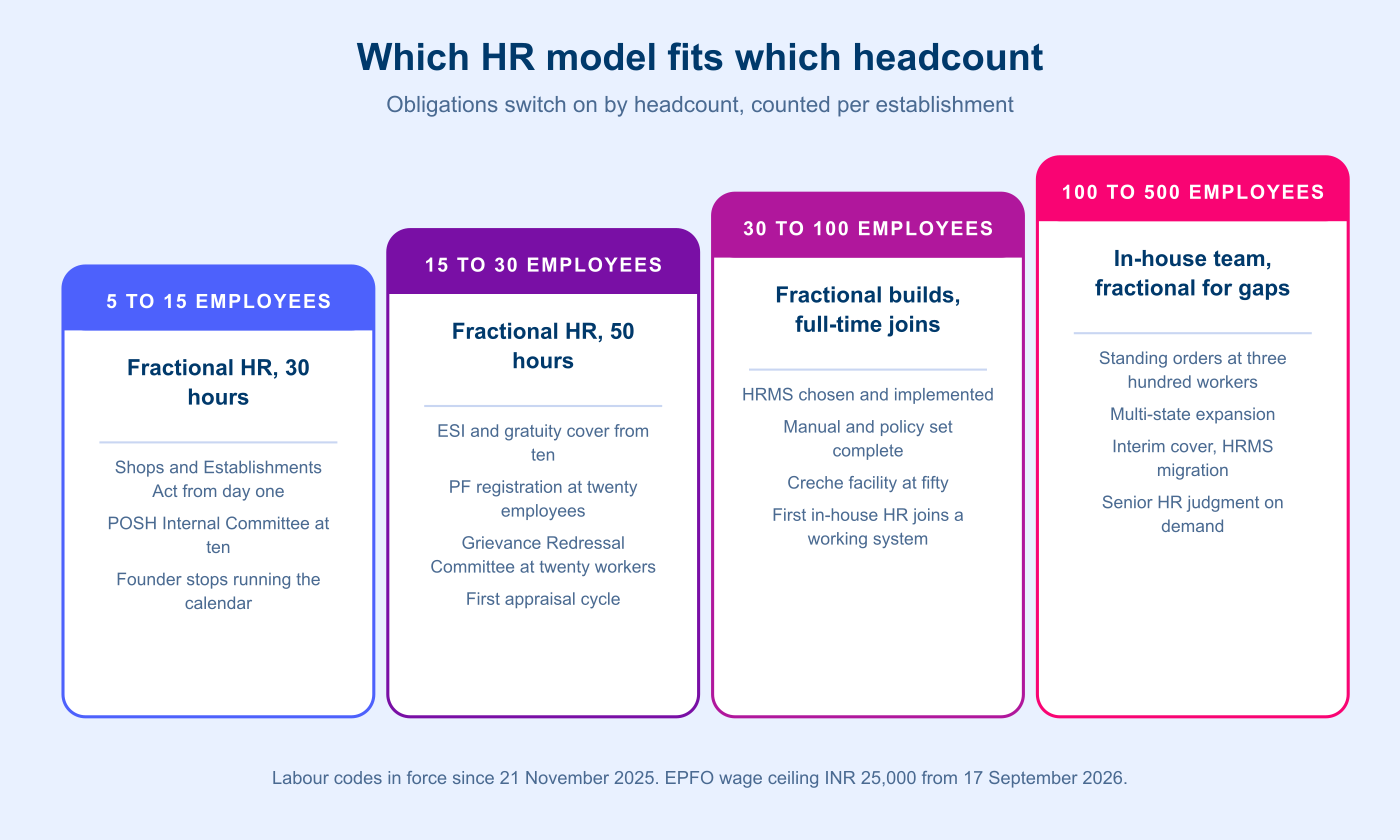
Five to fifteen employees, no HR. The compliance calendar has started and the founder is running it. This is the stage the model was built for: a fixed monthly fee, the policies and letters put in place once, and a named person for the employees to go to. DPIIT-recognised startups at this stage can use unHR's Startup India programme, which adds a policy set and a discount on the standard plans.
Fifteen to thirty employees, hiring fast. The POSH committee is mandatory, provident fund registration is close or done, and the first appraisal cycle is due. The statutory work now recurs monthly and the people work is weekly. A fractional manager at 50 hours a month typically covers this without a full-time hire.
Thirty to one hundred employees, first full-time HR hire in view. Here the question becomes sequencing. Many companies use the fractional manager to build the function, choose and implement the HRMS, write the manual, and then hire the first full-time HR person into a working system rather than an empty one. The fractional engagement then either ends or steps back to advisory hours.
One hundred to five hundred employees with an HR team. Fractional support is now for specific gaps: an HRMS migration, a multi-state expansion, interim cover, or senior HR judgment the team does not yet have. unHR services only companies under 500 employees, and states this on its pricing page, because above that size the economics of the model stop working.
Incubators and accelerators. A different buyer with the same problem across a portfolio. A shared HR desk gives every incubatee the same policy baseline and compliance cover, which is what unHR's startup hub programme offers to incubators and their portfolio companies.
Where it does not fit: a company that needs someone in the office every day for reasons of culture or shift operations, a factory or site-based business with daily labour-law exposure, or a company above the size where one person's fraction is enough. In those cases the right answer is a full-time hire, and a good fractional provider will say so.
What it costs: fractional HR against a full-time HR manager in India
Most cost comparisons for this topic quote a salary and a retainer and stop. The salary is only the first line of what a full-time hire costs, and the comparison is more useful when the statutory add-ons, the hiring cost and the hours actually delivered are on the same page.
The salary anchor is PayScale's India figure for an HR manager: an average of INR 8,48,380 a year across 1,212 salary profiles as of 1 July 2026, with the tenth to ninetieth percentile running from INR 3,13,000 to INR 20,00,000. Startups in Bengaluru, Mumbai and Delhi NCR tend to sit above the average for a manager with real compliance experience. The month below uses the average.
| Model | Monthly cost to the company | Hours of HR work delivered | Statutory add-ons | Time to start | Seniority you get | How it ends |
|---|---|---|---|---|---|---|
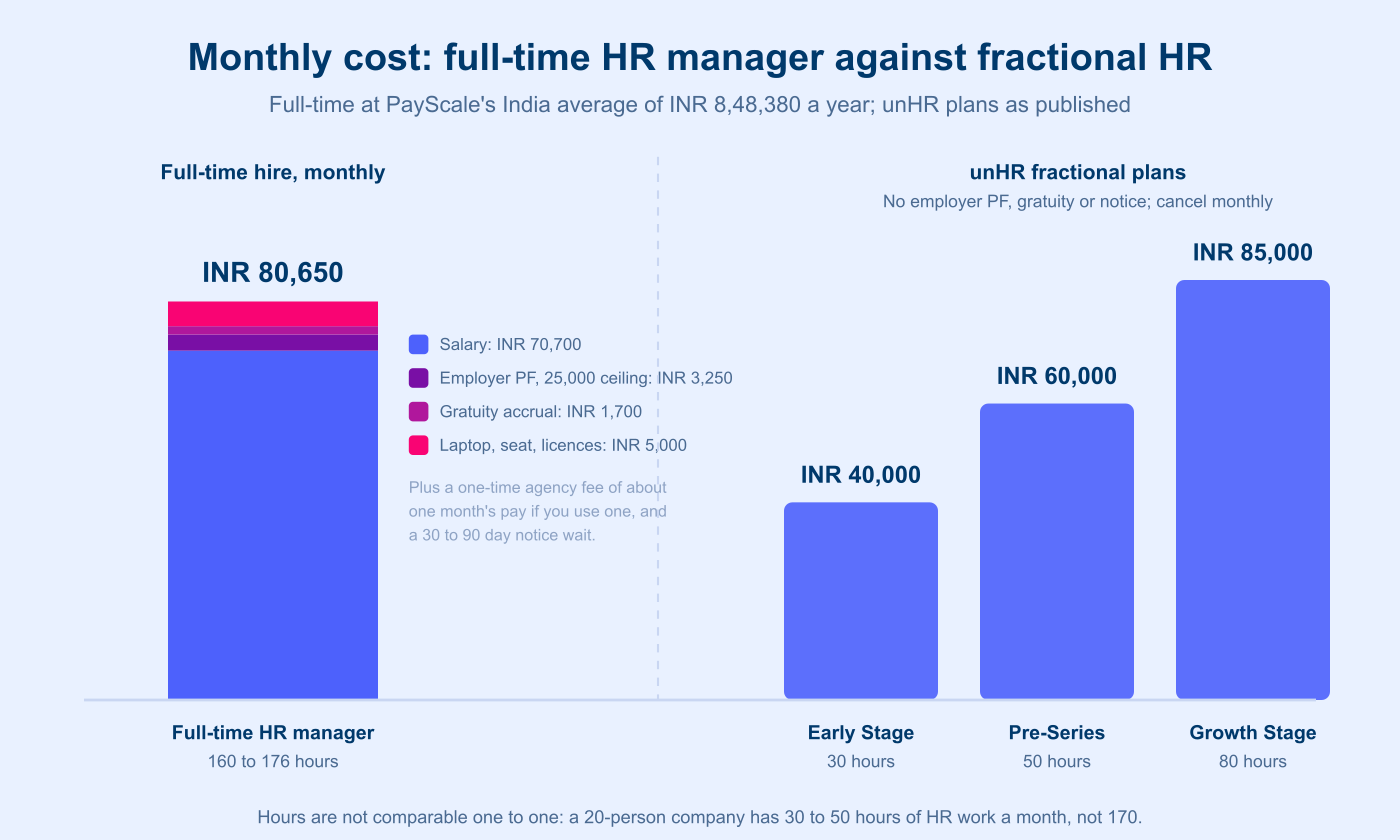
| Full-time HR manager (average salary) | About INR 80,000: INR 70,700 salary, INR 3,250 employer provident fund at the new INR 25,000 ceiling, about INR 1,700 gratuity accrual on a basic wage at half of gross, plus a laptop, seat and software licences | 160 to 176 working hours a month, whether or not the company has that much HR work | Employer PF, EDLI and administrative charges, gratuity after five years, leave encashment, maternity benefit, notice pay on separation | Six to twelve weeks: search, interviews, offer, and a 30 to 90 day notice period at the previous employer; an agency fee of about one month's CTC if you use one | One mid-level generalist at this salary; senior compliance judgment costs materially more | Notice period, full and final settlement, and the function stops until the replacement joins |
| Fractional HR manager (unHR Early Stage plan) | INR 40,000 a month for 30 hours, INR 60,000 for 50 hours, INR 85,000 for 80 hours; yearly plans at INR 4,30,000, INR 6,45,000 and INR 9,20,000 | 30, 50 or 80 tracked hours a month, sized to the headcount, with task and hour visibility through the provider's project tool | None; the HR manager is the provider's employee, so PF, gratuity, leave and notice sit with the provider | Days, not weeks; the provider assigns a trained manager and the onboarding checklist starts the same week | A certified HR manager backed by a team that has set up HR for 300 or more startups, with the escalation path built in | Monthly plan, cancel at the end of any month; the documents, policies and HRMS configuration stay with the company |
| HR consultant on a project | Quoted per project; useful for a policy manual or an appraisal design, expensive as a substitute for the monthly function | Only the project scope | None | Depends on the consultant's pipeline | Often senior, but not present when the complaint or the inspection arrives | At delivery; the running of what was delivered returns to the founder |
Three things in that table decide most purchases.
The full-time hire is not INR 70,000; it is closer to INR 80,000 recurring plus a one-time hiring cost of roughly one month's pay if an agency is used. The provident fund line will rise further for employees whose basic wage sits between the old and new ceilings.
Hours are not comparable one to one, and should not be. A 20-person company does not have 170 hours of HR work a month. It has 30 to 50 hours of work that must be done correctly and on time. Paying for a full month of a mid-level generalist to get that is the expensive option, not the safe one.
The risk cost is asymmetric. The fine for failing to constitute a POSH committee is up to INR 50,000. A mishandled exit that reaches a labour officer costs more than a year of fractional HR. Neither number appears on the salary line of either option.
How to choose a fractional HR provider in India
The market has grown quickly since 2024, and the label fractional HR now covers everything from a solo consultant with three clients to a provider with a trained bench. The six checks below separate them.
Ask who the named person is and how many hours you get
A retainer without a named HR manager and a stated number of hours is a helpdesk. Ask for the name, the experience, the days they will be with you, and where the hours are logged. A provider that tracks tasks and hours in a project tool you can see is showing you its operating model; one that cannot answer is asking you to trust an invoice.
Test Indian labour-law depth with a dated question
Ask what changed for your company on 21 November 2025 and on 17 September 2026. A provider who works in this market answers with the 50 percent wage rule, gratuity for fixed-term staff after one year, PF coverage at 20 employees, and the INR 25,000 provident fund ceiling. A provider whose material still describes the Industrial Disputes Act or a 45-day grievance clock has not updated since the codes took effect.
Check the scope against your headcount ladder
Write down the obligations that switch on at your next two headcount thresholds, then ask whether each sits inside the retainer or is priced as extra. POSH committee constitution and training at ten, provident fund registration and a Grievance Redressal Committee at twenty, creche facility at fifty. A plan that lists onboarding, appraisals, exits and policy review as included, and candidate sourcing as excluded, is being clear; that clarity is the thing to buy.
Ask which HRMS they implement and who owns the data
The HR function should leave a system behind, not a folder of spreadsheets. Ask which platforms the provider has implemented, whether the licence is in your company's name, and what happens to the configuration if the engagement ends. unHR implements Zoho People, Zoho Payroll, greytHR and Zoho Recruit in the client's own account, which is the arrangement to insist on with any provider.
Speak to two clients at your stage, not the logos
Ask for a reference from a company at your headcount that has been a client for more than six months, and one that has stopped being a client. What you want to hear from the first is how a complaint or an exit was handled. What you want to hear from the second is whether the handover to their full-time HR was clean. Both answers tell you more than the number of logos on the website.
Get the commercial terms in writing, including the exit
Monthly or annual, what the annual discount is, what notice either side gives, whether onboarding is charged, and confirmation that policies, letters and system access belong to your company. A monthly plan with no lock-in is the right default at the early stage; move to an annual plan when the engagement has proven itself, not before.
Mistakes Indian companies make with fractional HR
Buying a US-style fractional CHRO for a 12-person company. Strategic advice is not what a 12-person company is short of. It is short of someone to file the ESI return and write the appointment letter. Buy the operating function first.
Treating the fractional manager as a payroll vendor. If the only contact is a monthly data file, the people work that justifies the fee is not happening. Put the HR manager in the weekly leadership meeting.
Keeping the function in the founder's inbox. Employees should know who to write to. Announce the HR manager, give them a company email address, and route complaints, leave requests and payslip questions to them from the first week.
Not counting the second office. A team in a second state means a second Shops and Establishments registration, and possibly a Labour Welfare Fund and professional tax regime the first state did not have. Tell the provider before the office opens, not after the first inspection.
Waiting for the full-time hire to fix compliance. The full-time hire takes two to three months to arrive and another month to find their feet. The provident fund and POSH obligations are already running.
Skipping the handover. When the first full-time HR person joins, the fractional manager's last job is to hand over a working system and a documented calendar. Budget a month of overlap for it.
What an embedded HR manager from unHR does
unHR runs the model this guide describes. A certified HR manager is placed with your company as its HR business partner for a contracted number of hours a month, managing the employee life cycle from onboarding to exit: appointment letters, attendance and leave, engagement, appraisals, grievance redressal and off-boarding including full and final settlement. The managers are trained in house on HRMS platforms and are backed by a management team that has run its own companies, with tasks and hours tracked online so the client can see both. unHR has served more than 300 startups, has a physical presence in seven cities including Delhi NCR, Mumbai, Bengaluru, Hyderabad, Ahmedabad and Jaipur, and is an enlisted HR partner on the NSRCEL startup kit at IIM Bangalore.
The Early Stage plan is INR 40,000 a month for 30 hours, Pre-Series is INR 60,000 for 50 hours and Growth Stage is INR 85,000 for 80 hours, each with a yearly option that adds two free months. Every plan includes pre-joining formalities, onboarding, engagement, appraisals, exit formalities and policy review; candidate sourcing is priced separately through unHR's referral-led recruitment service. DPIIT-recognised startups get a policy set and a discount through the Startup India programme. If you would rather describe your company and hear which plan fits, talk to the unHR team.
Frequently asked questions
What is fractional HR?
Fractional HR is an arrangement in which an experienced HR manager works for a company for a fixed share of their time, usually 30 to 80 hours a month, rather than as a full-time employee. The company gets a named person who runs onboarding, statutory filings, policies, appraisals, grievances and exits, and pays a monthly fee instead of a salary with provident fund, gratuity and notice obligations. In India the model is delivered mainly by providers who employ and train the HR managers and place them with several client companies.
How much does fractional HR cost in India?
Published Indian retainers for an embedded HR manager start at about INR 40,000 a month for 30 hours and rise to about INR 85,000 for 80 hours; unHR's plans sit at INR 40,000, INR 60,000 and INR 85,000 with yearly options. A full-time HR manager on PayScale's India average of INR 8,48,380 a year costs the company about INR 80,000 a month once employer provident fund and gratuity accrual are added, before hiring costs. US-style fractional CHRO retainers quoted in dollars are a different product at a different price and are not a useful benchmark for a company under 100 employees.
Is fractional HR the same as outsourcing HR or using a PEO?
No. Under a PEO or contract staffing arrangement your people are employed by the staffing company. Under fractional HR your employees remain your employees, on your payroll and your letters, and the fractional manager runs the HR function for them. HR outsourcing in India often means only payroll processing; fractional HR includes payroll inputs but is mainly the people work and the statutory calendar around it.
At what headcount should a startup hire a full-time HR manager instead?
There is no statutory threshold; it is a workload question. Below about 30 employees the HR work rarely fills a month. Between 30 and 100 the first full-time hire usually makes sense, and many companies use the fractional manager to build the function and the HRMS first so the full-time person joins a working system. Above 100 an HR team is normal and fractional support is used for specific gaps such as system migration, multi-state expansion or interim cover.
Can a fractional HR manager handle PF, ESI, POSH and labour-code compliance?
Yes, and for most small companies that is the core of the job. Provident fund and ESI contributions are due by the 15th of the following month; the POSH Internal Committee is mandatory from ten employees; provident fund coverage and a Grievance Redressal Committee follow at twenty. Since the labour codes took effect on 21 November 2025, and the EPFO wage ceiling moved to INR 25,000 from 17 September 2026, the calendar has changed enough that experience across several companies is an advantage over a first-time in-house hire.
Does fractional HR work for larger companies?
For companies with an HR team already in place, fractional support is used for defined needs rather than the whole function: an HRMS implementation, a policy refresh after the labour codes, an expansion into a new state, or interim cover while a senior HR role is vacant. unHR works with companies up to 500 employees; beyond that size the economics of a shared HR manager stop working and an in-house team is the right structure.
Sources
Prime Minister's Office, Cabinet approves enhancement of EPFO wage ceiling from Rs.15,000 to Rs.25,000 per month, 16 September 2026: pmindia.gov.in
Employees' Provident Fund Organisation, contribution rates: epfindia.gov.in
Employees' State Insurance Corporation, contribution (employer 3.25 percent, employee 0.75 percent, from 1 July 2019): esic.gov.in
Ministry of Labour and Employment, the four labour codes and central rules: labour.gov.in
The Sexual Harassment of Women at Workplace (Prevention, Prohibition and Redressal) Act, 2013, Ministry of Women and Child Development: wcd.gov.in
Delhi Shops and Establishments Act, 1954 and the 2026 amendment, Labour Department, Government of NCT of Delhi: labour.delhi.gov.in
PayScale, Human Resources (HR) Manager salary in India, 1,212 profiles, updated 1 July 2026: payscale.com
Press Information Bureau, DPIIT-recognised startups, 2,12,283 entities as on 31 January 2026: pib.gov.in
unHR pricing, HR business partner, HR tech implementation and Startup India programme pages: unhr.in