Delhi NCR startups are not choosing between good and bad HR consultants. They are choosing between four different models: a recruitment agency that fills roles, a staffing firm that supplies contract headcount, an outsourced HR team that runs the back office, and an embedded HR manager who sits inside your company as your HR function. The right pick depends on headcount, how many of Delhi, Haryana and Uttar Pradesh you employ people in, and whether your problem is hiring or everything after hiring.
Delhi NCR is three HR problems wearing one name
A founder with a registered office in Delhi, an engineering team in Gurugram and a support desk in Noida has one company and three state labour regimes. That is the fact most “top HR firms in India” listicles never mention, and it is the single biggest reason generic HR advice fails here.
Shops and establishments registration, the licence every office needs, is state law. Delhi runs the Delhi Shops and Establishments Act, 1954. Gurugram and Faridabad run the Haryana Shops and Commercial Establishments Act, 1958. Noida, Greater Noida and Ghaziabad run the Uttar Pradesh Dookan Aur Vanijya Adhishthan Adhiniyam, 1962. Three registrations, three sets of working-hour and leave rules, three inspectorates, one team that thinks of itself as sitting in “Delhi NCR”.
Professional tax is the pleasant surprise: none of Delhi, Haryana or Uttar Pradesh levies it, which catches out founders relocating from Bengaluru, Mumbai or Kolkata. The Labour Welfare Fund is where the divergence comes back. Delhi’s applies from five employees and is deducted half-yearly, in June and December. Haryana’s applies from ten, is deducted monthly, and is indexed rather than flat: the caps moved to INR 35 for the employee and INR 70 for the employer on 1 January 2026. Uttar Pradesh has no Labour Welfare Fund at all. Three offices, three different answers, one of them being that the deduction does not exist.
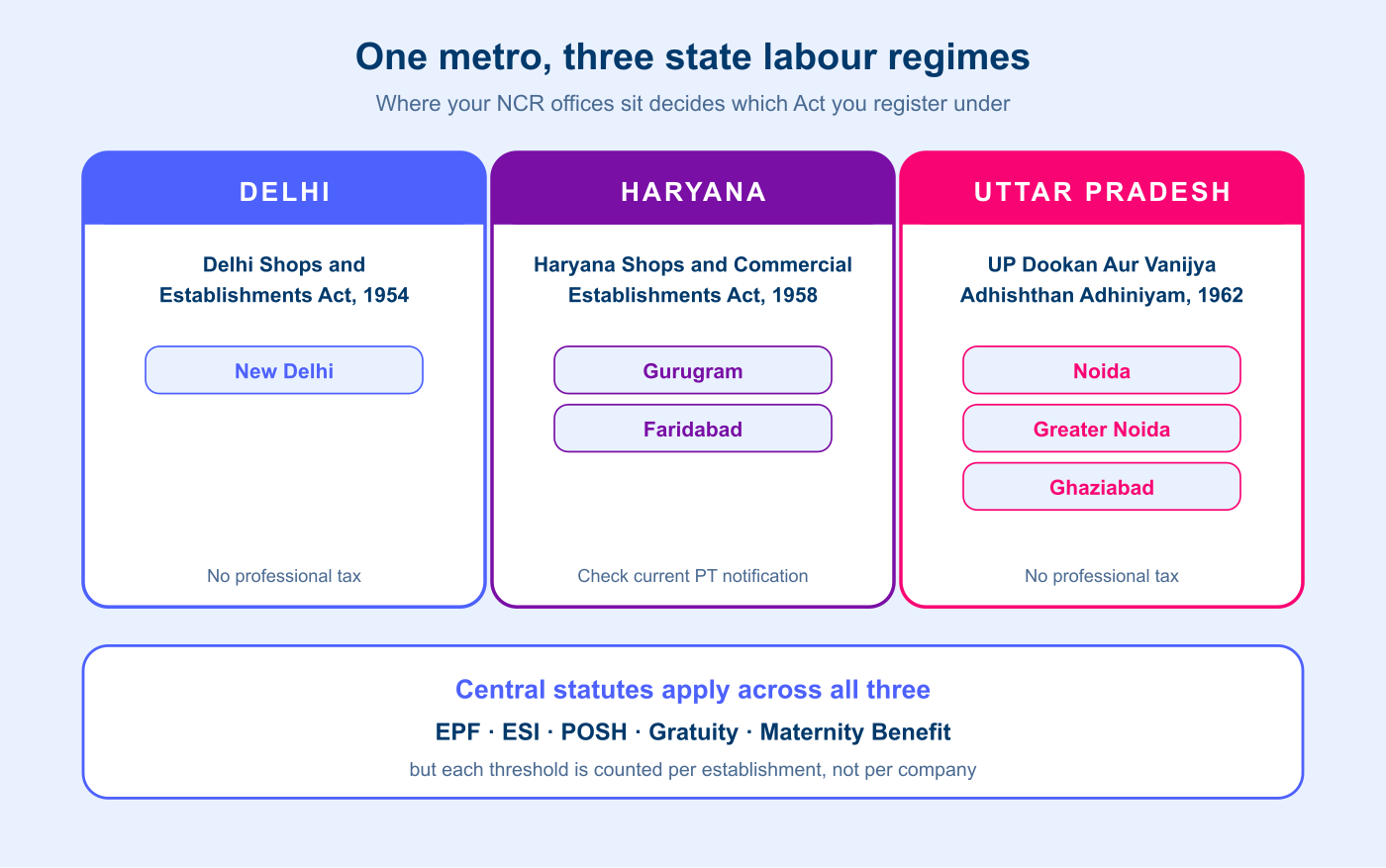
Central statutes such as EPF, ESI and POSH apply across all three, but they switch on at headcount thresholds counted per establishment, which means a company can trip a threshold in one office and not another. An HR partner who cannot answer “which of my three offices just crossed twenty people” is not solving the Delhi NCR problem.
What changed on 21 November 2025
India’s four labour codes came into force on 21 November 2025, folding twenty-nine separate statutes into the Code on Wages, the Code on Social Security, the Industrial Relations Code and the Occupational Safety, Health and Working Conditions Code. The central final rules followed on 8 May 2026.
Labour is a Concurrent List subject, so every state frames and notifies its own rules, and they are not moving in step. That is the part that bites here: a company with offices in Delhi, Haryana and Uttar Pradesh can be sitting on three different rule-sets on three different timelines, in one metro, at the same time.
Three changes reach a startup’s payroll immediately.
The fifty per cent wage rule. Excluded allowances cannot exceed half of total remuneration. Anything above that is reclassified as wages, so provident fund and gratuity are computed on at least half of pay. If your salary structure was built to keep basic low, your employer cost went up on 21 November 2025 whether or not anyone told you.
Gratuity for fixed-term employees now vests at one year, not five. If you hire on fixed-term contracts, this is a liability you did not have two years ago.
Provident fund reaches every establishment with twenty or more employees, not only the scheduled industries the 1952 Act listed.
This is also the single most useful question to put to a prospective HR partner right now. If they cannot tell you which of your offices is operating under final state rules and which is still on draft, they are not tracking the thing that changed.
Four models of HR support, and who each one is for
“HR consultant” covers four businesses that do genuinely different work. Buying the wrong one is the most common and most expensive mistake founders make here.
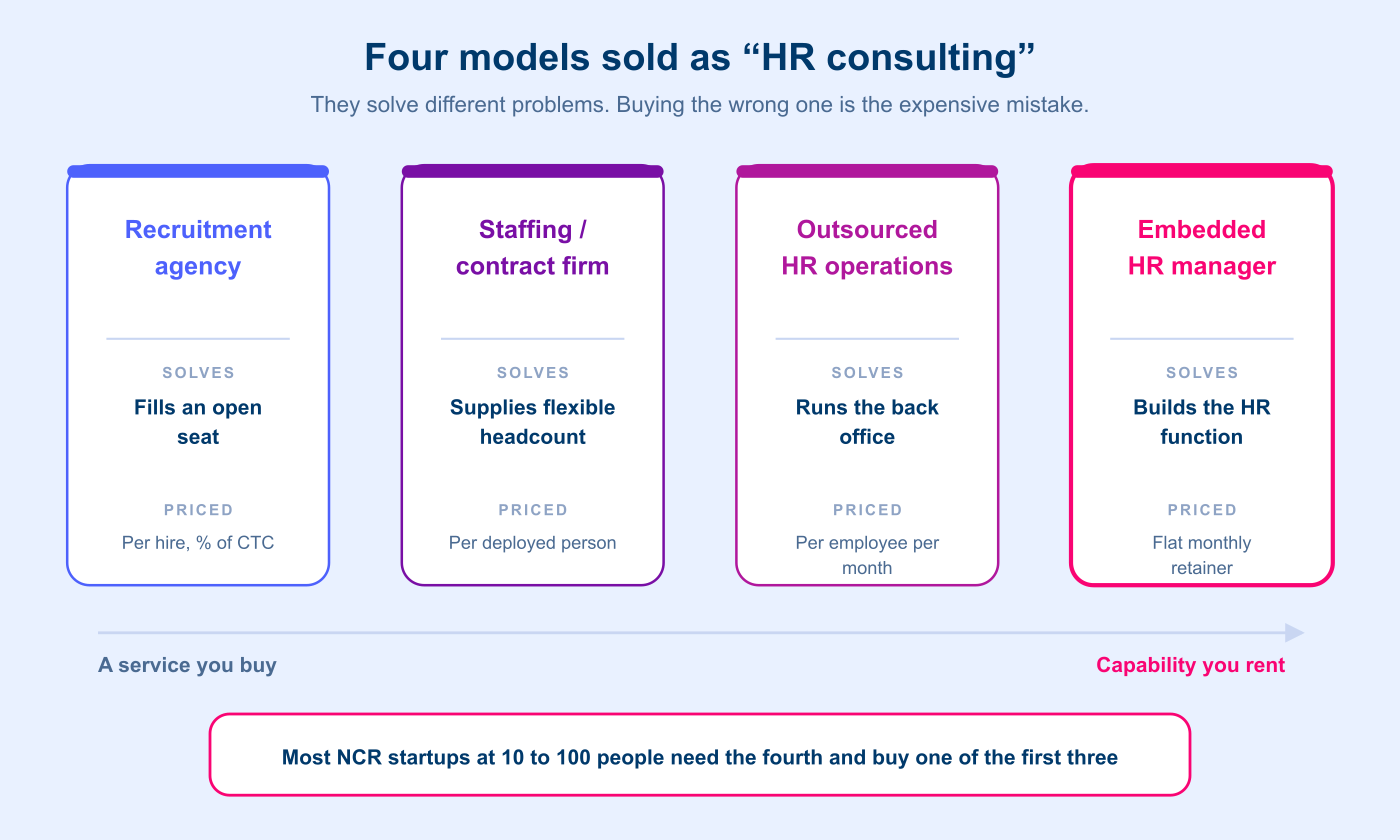
Recruitment agency. Paid per hire, usually a percentage of annual salary. Solves an empty seat. Does not touch payroll, compliance, policy or exits. Right when hiring is your only bottleneck.
Staffing and contract firm. Puts people on their payroll and deploys them to you. Solves headcount flexibility and keeps contract-labour compliance off your books. Right for seasonal load, field teams and short projects.
Outsourced HR operations. A vendor runs payroll, records, onboarding and filings from their office. Solves the back office. Right when the work is transactional and volume is steady.
Embedded HR manager. A certified HR professional works inside your company part-time as your HR business partner: your policies, your systems, your team, your calendar. Right when the problem is not one seat or one process but the absence of an HR function.
The first three are services you buy. The fourth is capability you rent until you can hire it. Most Delhi NCR startups between ten and a hundred people need the fourth and buy one of the first three, then wonder why compliance still slips.
The Delhi NCR landscape: what each firm is built for
Below is a factual read of four firms that serve startups in this region, based on what each publishes on its own site as of August 2026. This is a capability map, not a ranking. The firm that is wrong for you at fifteen people may be exactly right at eighty.
| Option | Primary model | Base | Published scale | Best fit |
|---|---|---|---|---|
| AUR Consultant | Staffing and recruitment led, plus payroll and onsite HR | Delhi | “Over 11 years of experience”; “1000+ clients served across sectors” | Volume hiring and contract staffing across sectors |
| Hawkhire | Recruitment led, plus HR policy and payroll outsourcing | Gurugram | Positions on “end-to-end HR solutions for startups”; 12+ sectors listed | Early-stage hiring in the Gurugram corridor |
| Peopleora | Outsourced HR operations and compliance | Ghaziabad | “Trusted by 50+ startups” | Steady-state back-office HR for growing teams |
| unHR | Embedded HR manager plus HRMS implementation | New Delhi and Gurugram, plus Noida, Mumbai, Bengaluru, Hyderabad, Ahmedabad and Jaipur | 300+ startups served; 30+ certified HR managers | Funded startups building an HR function for the first time |
Read the table by model, not by name. If you have forty open roles, the staffing-led firms are the answer and we would tell you so. If you have twenty-two employees, no HR person, a PF registration you have not completed and an appraisal cycle nobody owns, no number of recruiters fixes that.
The thresholds that decide when you actually need help
India’s HR obligations arrive on a headcount ladder, not on a funding milestone. These are the rungs Delhi NCR founders hit, in order.
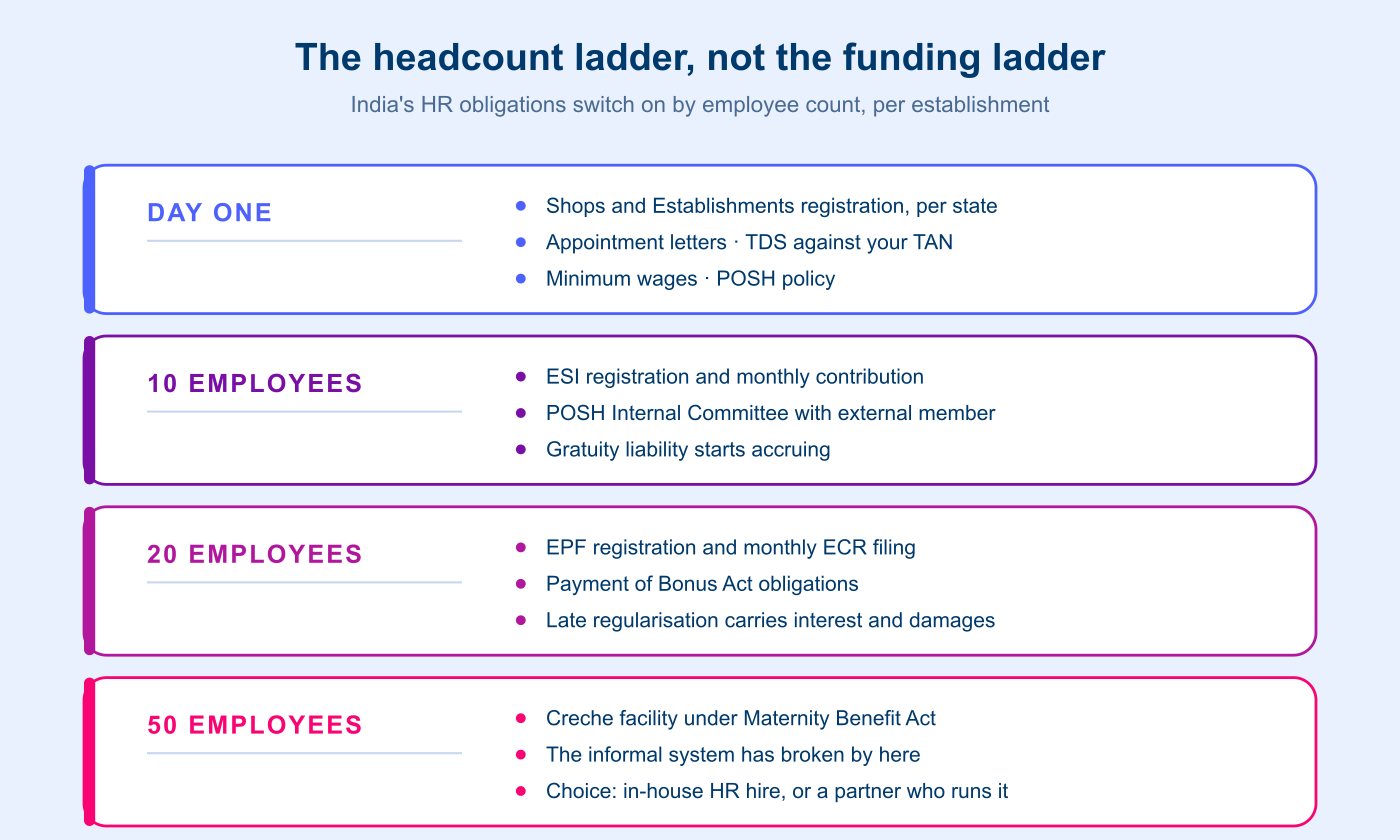
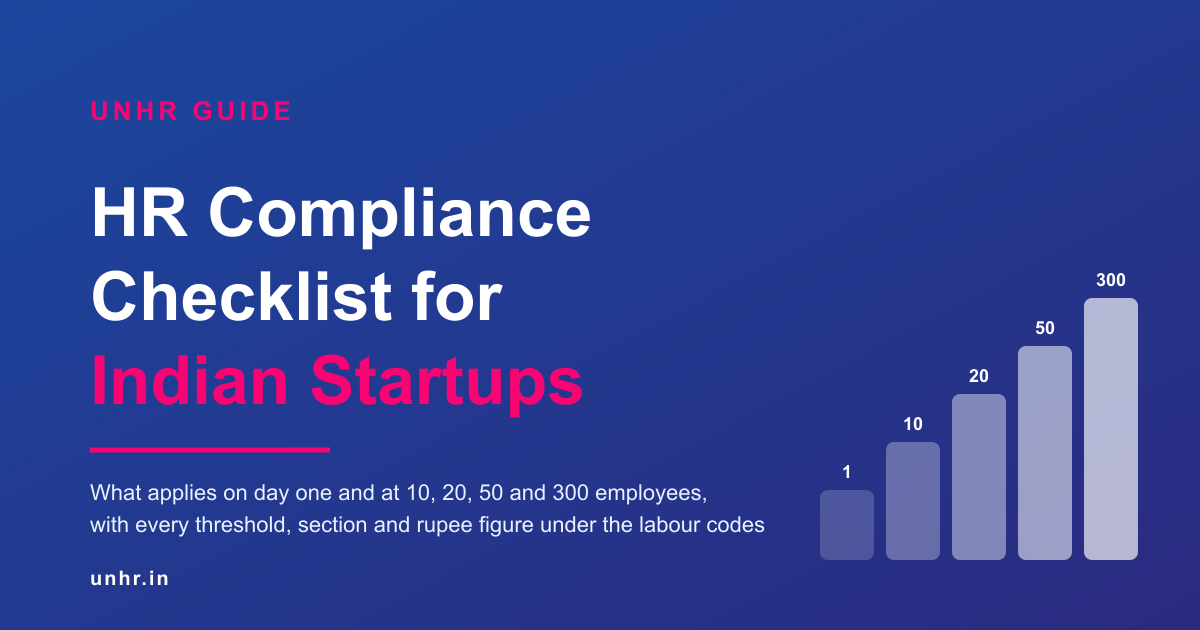
Day one. Shops and establishments registration in each state you have an office in. An appointment letter for every employee, now a statutory entitlement rather than good practice. TDS on salaries against your TAN. Minimum wages for the applicable state and skill category. A POSH policy, even before the committee is required. And a salary structure that survives the fifty per cent wage rule.
Five employees, in Delhi only. The Delhi Labour Welfare Fund, deducted half-yearly in June and December. Your Gurugram office does not hit its equivalent until ten, and your Noida office never does.
Ten employees. ESI registration, covering employees drawing up to INR 21,000 a month gross, or INR 25,000 for employees with disabilities. A POSH Internal Committee with an external member, and an annual report to the District Officer. Gratuity liability begins to accrue. In Haryana, the Labour Welfare Fund starts here too, deducted monthly.
Twenty employees. Provident fund registration and monthly ECR filing, now regardless of which industry you are in. Bonus obligations. This is the rung where founders most often discover that “we will regularise it later” has an interest and damages component.
Fifty employees. A creche facility, carried into the Code on Social Security. At this size the informal system has usually broken, and the choice becomes an in-house HR hire or a partner who can run it properly.
Every rung is per establishment. Fifteen people in Gurugram and eight in Noida is not twenty-three people for every purpose, and getting that wrong in either direction costs money.
Seven questions to ask before you sign
Which of the four models are you actually selling me? If the answer is “all of them”, ask which one they staff for.
Who is the named person on my account, and what are they certified in? An agency relationship with no named HR professional is a queue, not a partner.
How many days a month do I get, and what happens on the other days? Retainers that do not define capacity define nothing.
Show me how you would handle a Delhi office and a Gurugram office. The answer tells you in thirty seconds whether they know this region.
Which HRMS do you implement, and who owns the data if we part ways? Your employee master data should live in your tenant, not theirs. Our guide to choosing between payroll software and a full HRMS covers what to look for.
What is the notice period on the contract? Annual lock-ins are a vendor convenience, not a client benefit.
What does month one look like? A partner who cannot describe the first thirty days concretely has not done this before.
Consultant, outsourced team, or your first in-house HR hire?
The honest comparison is against a salary. A competent HR generalist in Delhi NCR who can own compliance, payroll, hiring coordination and employee relations is a mid-level hire, and you will spend six to ten weeks finding them. Below roughly fifty employees, most startups do not have enough HR work to keep that person engaged, but they have far too much to leave with the founder or the office manager.
That gap is what the embedded model exists for. unHR places a certified HR manager inside your company as your HR business partner, working your policies and your systems rather than routing your work through a vendor queue. The Startup Pack is INR 40,000 a month, cancel anytime, with no long-term commitment. When the volume justifies a full-time hire, the function is already built and documented, and we help you recruit into it.
Alongside the person, we implement the HRMS so attendance, leave, payroll and records stop living in spreadsheets. DPIIT-recognised startups can see the startup-specific engagement here, and if you would rather just talk it through, book a conversation. If a complaint lands before any of that is in place, our guide to handling employee grievances without an HR team sets out the process a founder can run. If you are weighing that model against a full-time hire, our guide to fractional HR in India sets out the rupee comparison and the headcounts it suits.
Frequently asked questions
What do HR consultants for startups in Delhi NCR actually do?
It depends on the model. Recruitment firms fill roles for a per-hire fee. Staffing firms supply people on their own payroll. Outsourced HR vendors run payroll, records and statutory filings from their office. Embedded HR partners place a certified HR manager inside your company to build policies, run compliance, manage employee relations and implement your HRMS. Most founders searching for a “consultant” need the last one and are shown the first.
How much does HR consulting cost for a startup in Delhi NCR?
Recruitment is usually charged as a percentage of the hired candidate’s annual salary. Outsourced HR operations are typically priced per employee per month. Embedded HR is a flat monthly retainer: unHR’s Startup Pack is INR 40,000 a month with no lock-in. For comparison, a full-time mid-level HR generalist in Delhi NCR costs meaningfully more once you add the hiring time and the risk of getting the hire wrong.
At what stage should a startup hire an HR consultant?
The practical trigger is ten employees, because that is where ESI registration, a POSH Internal Committee and gratuity accrual all switch on at once. The second trigger is twenty, when EPF registration and monthly filing begin. If you are approaching either rung with no HR owner, or you have just added an office in a second NCR state, that is the moment.
Do the new labour codes change what a Delhi NCR startup must do?
Yes, in three ways that show up on payroll. Excluded allowances are capped at half of total remuneration, so provident fund and gratuity are now computed on at least fifty per cent of pay and employer cost rose accordingly. Gratuity for fixed-term employees vests at one year instead of five. And provident fund now applies to every establishment with twenty or more employees rather than only listed industries. The codes have been in force since 21 November 2025 and central rules were notified on 8 May 2026, but each state notifies its own rules on its own timeline, so a company with Delhi, Gurugram and Noida offices may be under three different rule-sets at once.
Does a Delhi NCR startup need separate registrations for Gurugram and Noida offices?
Yes for shops and establishments registration, which is state law: Delhi, Haryana and Uttar Pradesh each have their own Act and their own registration. Central statutes such as EPF, ESI and POSH apply across all three, but their headcount thresholds are counted per establishment, so a company can cross a threshold at one office before another. Working hours, leave entitlement and holiday lists also differ by state and should be reflected in your policy, not averaged.
Sources
Labour Department, Government of NCT of Delhi, Delhi Shops and Establishments Act, 1954: labour.delhi.gov.in
Employees’ Provident Fund Organisation: epfindia.gov.in
Ministry of Labour and Employment, the four labour codes: labour.gov.in
Employees’ State Insurance Corporation: esic.gov.in
Firm claims quoted above are taken from each company’s own website: AUR Consultant, Hawkhire, Peopleora, accessed 23 August 2026.