Payroll software calculates salaries and handles statutory deductions (PF, ESI, professional tax, TDS) and payslips. An HRMS covers payroll plus attendance, leave, onboarding, employee records and performance in one system. For Indian startups under about 10 employees, payroll software is usually enough; once you cross 10-20 people, hire across states, or run a remote team, an HRMS pays for itself.
The choice every founder hits around hire number ten
Early on, the founder is the HR department. Salaries go out from a spreadsheet, leave lives in a shared calendar, and it works, until headcount crosses into the range where India's statutory obligations switch on: ESI at 10 employees, EPF at 20. From that point, manual HR is not just tedious, it accumulates compliance risk every month.
The first automation decision is almost always the same question: do we need payroll software, or a full HRMS (Human Resources Management System)? They are not competing products. One is a subset of the other, and the right answer depends on your headcount, your growth plan, and how many states you operate in.
What payroll software does
Payroll software does one job: pay people correctly and keep the statutory trail clean. In an Indian setup that means:
Salary calculation across fixed, variable and reimbursement components, with arrears handling
Statutory deductions computed each cycle: EPF, ESI, professional tax (state-wise) and TDS
Challan-ready output for PF and ESI deposits, due by the 15th of the following month
Payslips, bank transfer files, and year-end Form 16 generation
For a small team, this covers the highest-risk part of HR for the lowest cost, typically priced per employee per month. The compliance filings that attract interest and penalties when missed are exactly the ones it automates. What it deliberately does not do: onboarding, leave workflows, performance, or employee records beyond what payroll needs.
What an HRMS adds
An HRMS is the whole toolkit. Payroll sits inside it as one module, alongside the systems that manage the rest of the employee lifecycle:
Employee records: one master database for contracts, documents, and history, instead of five spreadsheets that disagree
Attendance and leave: automated capture, structured approval chains, and leave balances that match your state's Shops & Establishments rules
Onboarding and exits: document collection, asset tracking, and full-and-final settlement workflows
Performance: goal-setting and review cycles that actually run on a calendar
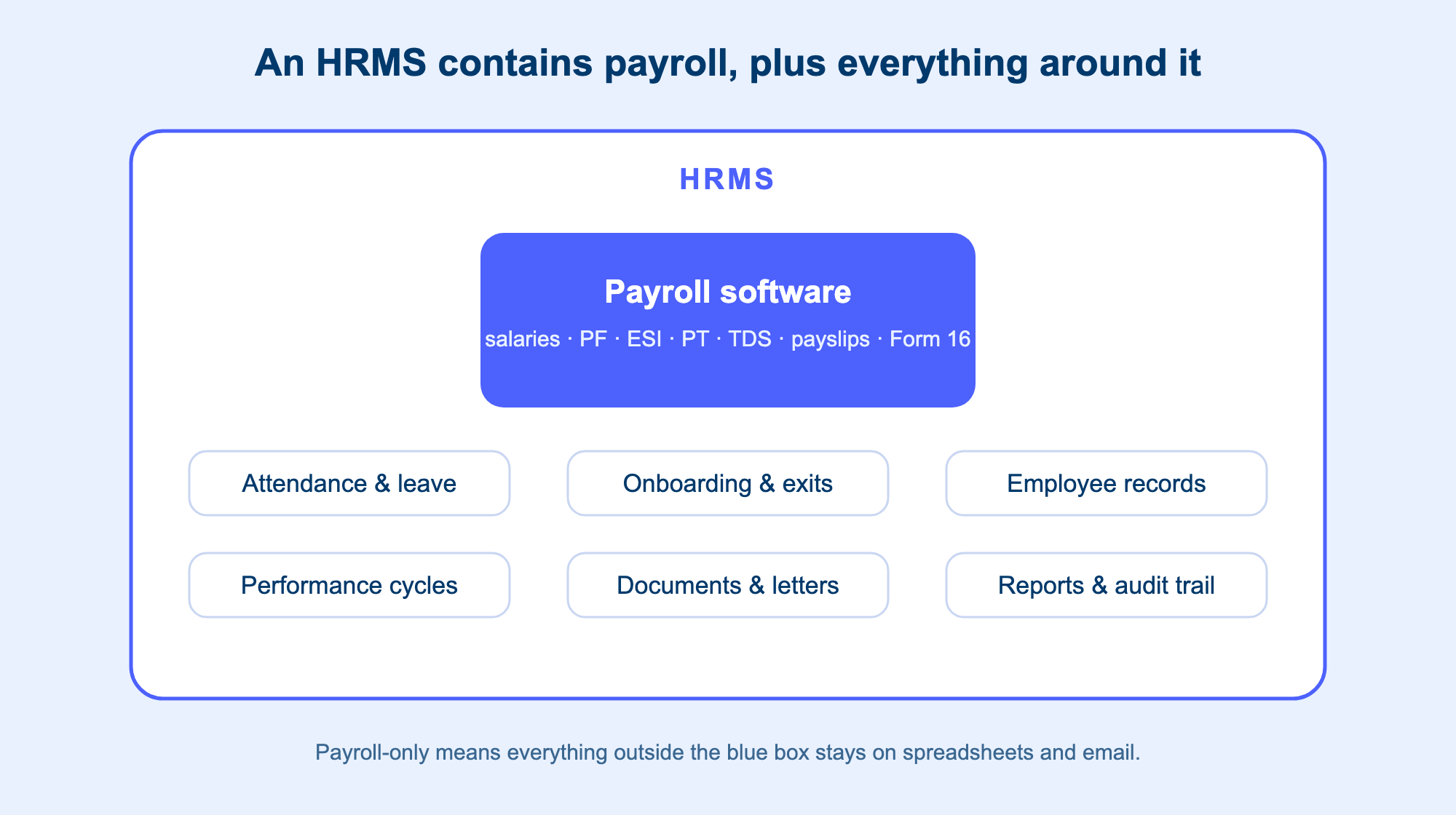
The practical win is one source of truth. Attendance flows into payroll without re-entry, a new hire exists in every module from day one, and an investor's HR due-diligence request becomes an export instead of a week of reconstruction.
| Option | Primary Focus | Key Functions | Complexity | Cost (Generally) | Scalability | Best Suited For |
|---|---|---|---|---|---|---|
| Payroll Software | Accurate salaries and statutory compliance | Salary calculation, PF/ESI/PT/TDS deductions, payslips, Form 16, challan-ready reports | Low; live in days | Lower; per-employee monthly pricing | Fine for payroll; everything else stays manual | Teams under ~10 employees, single state, straightforward salary structures |
| HRMS | The full employee lifecycle on one system | Payroll plus attendance, leave, onboarding, records, performance, exit workflows | Higher; needs a proper rollout | Higher per employee; implementation effort on top | Built for growing, multi-state and remote teams | 10+ employees, rapid hiring plans, multi-city or remote teams |
The differences that actually matter
Scope. Payroll software is a subset of an HRMS. Choosing payroll-only is a decision to keep running records, onboarding, leave and reviews on spreadsheets and email. That is a reasonable decision at 8 employees and an expensive one at 40.
One record or many. With standalone payroll, every employee exists in at least two places, and the copies drift. An HRMS keeps a single record, which is what makes attendance-to-payroll automatic and audits painless.
Compliance surface. Payroll tools handle the deduction-and-deposit cycle. An HRMS also carries the surrounding obligations: leave registers consistent with state law, documented exits, and the paper trail that funding due-diligence asks for.
Where each breaks. Payroll software never breaks from growth; the spreadsheets around it do, reliably somewhere between 40 and 60 employees, when leave disputes and onboarding drift start consuming founder time. An HRMS breaks only when it is bought but never properly rolled out.
When payroll software is the right call
Under ~10 employees, single state. Your statutory surface is small, and a payroll tool covers the risky part of it.
Runway is tight. Automate the function where errors cost money (deductions and deposits) and keep the rest manual a little longer.
Manual HR still works. If onboarding is a checklist and leave is a calendar and neither is causing disputes, you have not hit the threshold yet.
When an HRMS is the right call
You are crossing the statutory thresholds. ESI registration at 10 employees and EPF at 20 multiply your filing calendar; integrated attendance-leave-payroll keeps it accurate without re-entry.
You plan to double headcount in 12-24 months. Onboarding at scale on spreadsheets is where new-hire experience quietly dies.
You hire across states or remotely. Professional tax, Shops & Establishments rules and leave minimums fork per state; a system that knows the difference beats a founder who has to.
Diligence is coming. Clean, exportable people-data is one of the cheapest ways to look like a well-run company, because it is one.
The unHR decision framework
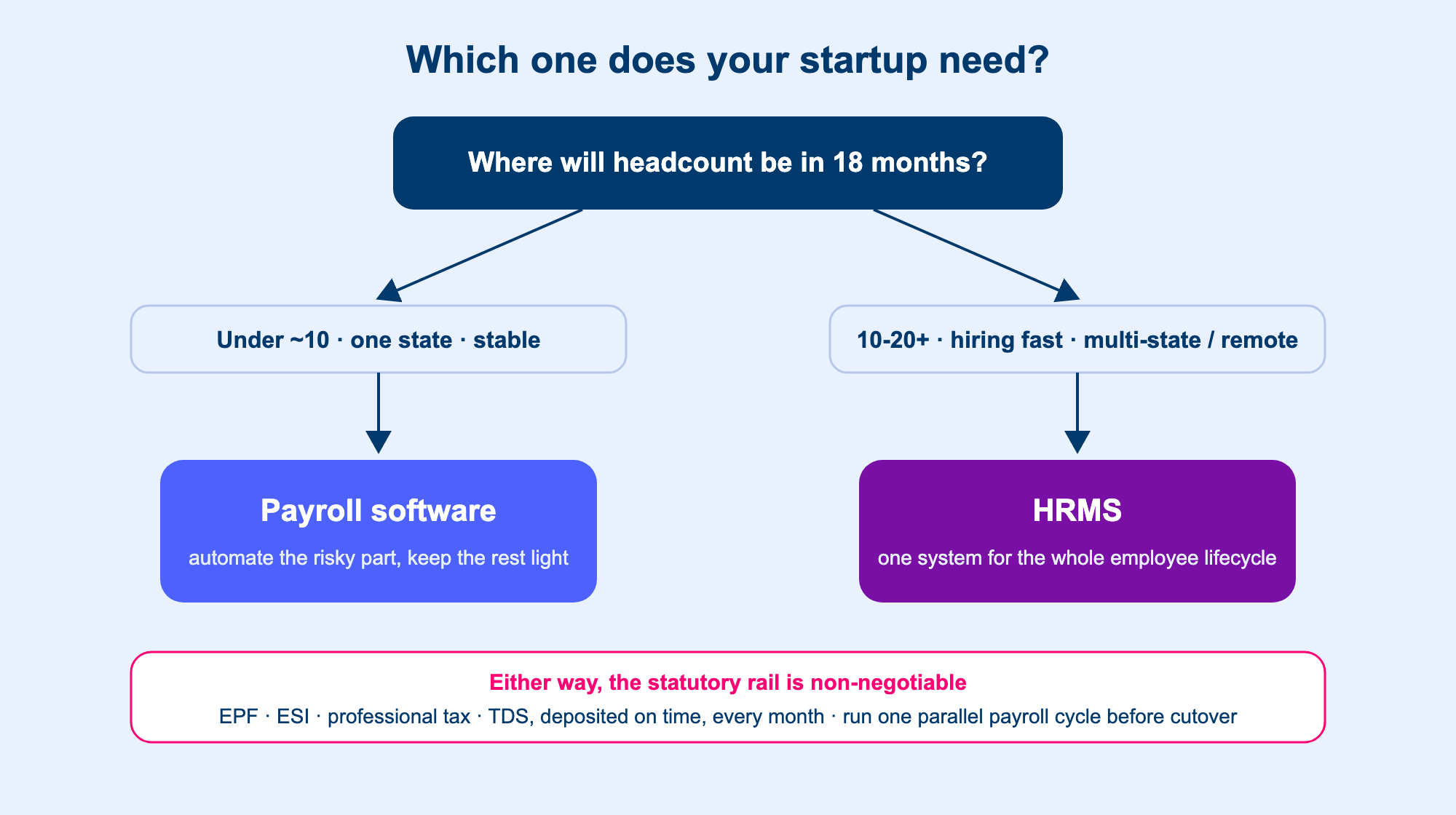
We use four questions with the startups we run HR for:
1. Where will headcount be in 18 months? Decide for that number, not today's. Migrating systems mid-growth costs more than starting one tier up.
2. What is already hurting? If the answer is "payday takes two days and I fear the PF challan," payroll software solves it. If the answer includes onboarding, leave disputes or scattered records, you are past payroll-only.
3. What can you administer? An HRMS needs an owner, even part-time. If nobody will own it, buy the simpler tool, or bring in someone whose job is to run it for you.
4. What must it talk to? At minimum your accounting stack; in India that usually means clean exports your accountant can reconcile. Native attendance-payroll integration is the one link worth paying for.
One implementation rule regardless of choice: run one parallel payroll cycle, old process and new system side by side, before you cut over. Every payday disaster we have been called into skipped that step.
Frequently asked questions
Does a 15-person startup in India need an HRMS?
At 15 employees you have crossed the ESI threshold and are approaching EPF at 20, so your compliance calendar is already real. If you are hiring toward 25-30, moving to an HRMS now is cheaper than migrating later; if headcount is stable, payroll software plus disciplined spreadsheets can hold.
Can we start with payroll software and upgrade to an HRMS later?
Yes, and it is a common path. The cost is the migration: employee master data, leave balances and salary history have to move cleanly. If you expect to upgrade within a year, starting on a modular HRMS and enabling only payroll is usually less total work.
What does it cost to run HR manually instead?
The visible cost is founder time on payday. The real costs surface later: late PF or ESI deposits attract interest and damages, leave records that contradict state law become disputes at exit, and reconstructing people-data for a funding due-diligence takes weeks. Manual HR is free the way an uninsured bike is free.
Choose for the company you are about to be
Payroll software gets salaries and statutory filings right for a small, single-state team. An HRMS carries the whole employee lifecycle once growth, hiring plans or multi-state operations raise the stakes. Decide on your 18-month headcount, insist on one parallel payroll run, and give the system an owner.
If you would rather not run this decision alone: implementing HR tech is one of the three things unHR does for startups every week. We will assess your setup, recommend a system (including our own HRMS add-on with automated attendance, structured leave approvals and compliant payroll, if it fits), and run the rollout so payday never notices the switch. Talk to an unHR manager. And if the system is only half the problem, our guide to choosing an HR consultant in Delhi NCR covers the four models of HR support and when each one fits. When a dispute does arrive, our guide to handling employee grievances without an HR team covers the process and the statutory clocks. For the cost of running the function itself, see our guide to fractional HR in India.
References
EPFO, Government of India: epfindia.gov.in (EPF applicability and deposit timelines) · ESIC, Government of India: esic.gov.in (ESI coverage and contribution rules) · Income Tax Department: incometaxindia.gov.in (TDS on salaries, Form 16).