An Indian startup needs a named person responsible for HR by its tenth employee, because that is when the POSH Internal Committee and ESI coverage become mandatory. That person does not have to be a full-time hire. Most startups do well with the founder plus payroll software up to about ten people, part-time or fractional HR from ten to roughly thirty, and a first full-time HR hire somewhere between thirty and sixty employees. Hire earlier if you are recruiting every week, have received your first grievance or POSH complaint, are raising a round, or have employees in more than one state. A full-time HR generalist costs an estimated INR 47,000 to INR 53,000 a month to the company; an HR manager an estimated INR 81,000 to INR 1,05,000.
Headcount sets the floor, signals set the timing
There is no law in India that says a company must employ an HR professional at a given size. What the law does is switch on obligations at fixed headcounts, and those obligations need an owner. At ten employees the company must constitute a POSH Internal Committee and register for ESI. At twenty it must register for provident fund, and an establishment with twenty or more workers must set up a Grievance Redressal Committee. Since the four labour codes came into force on 21 November 2025, every worker must also receive an appointment letter.
So the question has two parts. At what headcount must someone own HR work? Ten employees. When does that work justify a full-time salary? That depends on how fast you are hiring, whether people problems have started, whether investors are about to read your records, and how many states your team sits in.
The headcount ladder: which HR model fits at each size
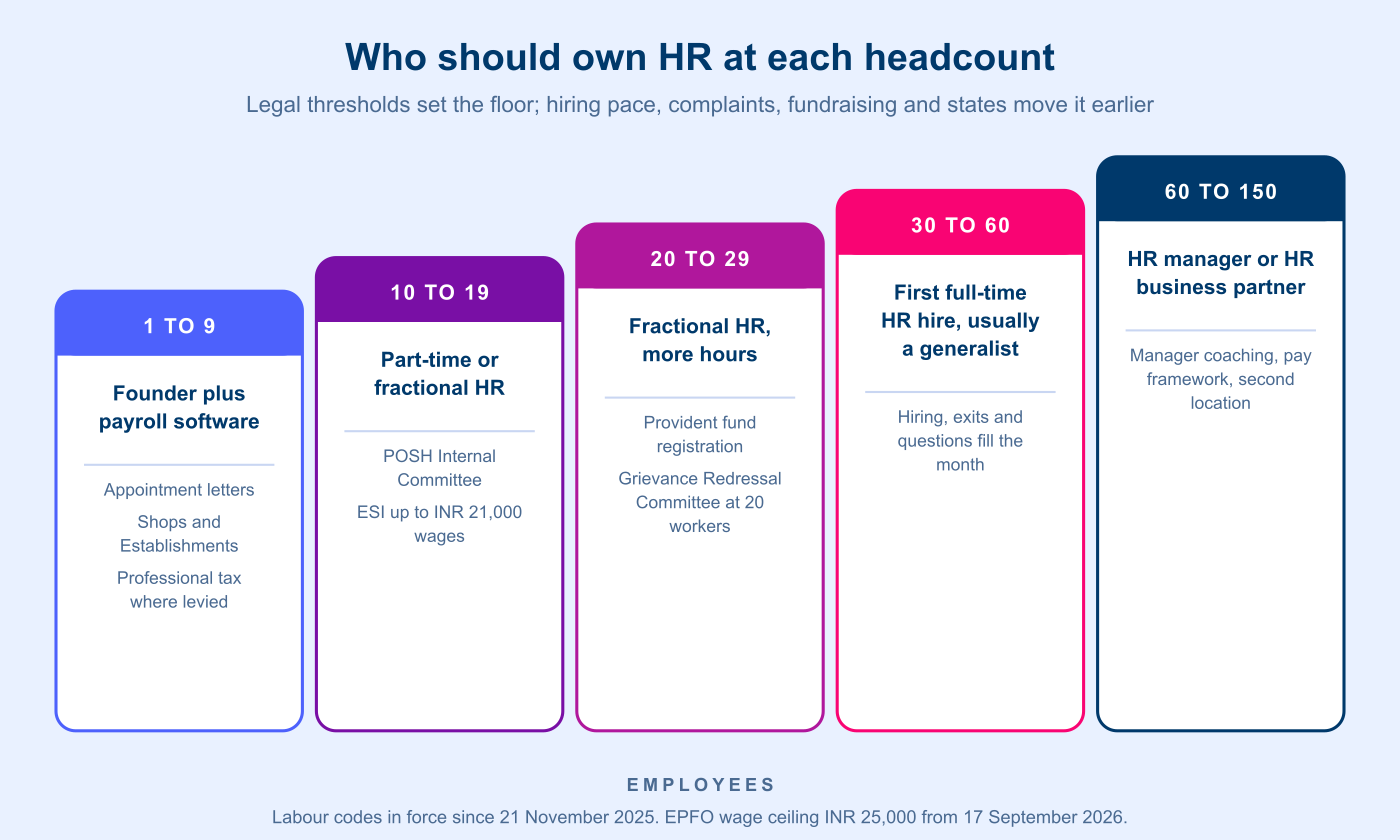
The table below is the default path for a services or technology startup with one office. The thresholds in the second column come from the labour codes and the POSH Act. The model in the third column is a judgement about workload, and the signals in the next section can move it earlier.
| Headcount | What switches on at this size | Who should own HR | Hours of HR work a month (estimate) | What to put in place |
|---|---|---|---|---|
| 1 to 9 employees | Appointment letters for every worker, Shops and Establishments registration in the state, professional tax where the state levies it | The founder or a co-founder, with payroll software | 5 to 15 | Standard offer and appointment letters, a leave policy, a payroll tool, one folder per employee |
| 10 to 19 employees | POSH Internal Committee; ESI registration for employees earning up to INR 21,000 a month | Part-time or fractional HR, with the founder as the decision maker | 20 to 35 | Internal Committee constituted and trained, POSH and grievance policies, a monthly compliance calendar |
| 20 to 29 employees | Provident fund registration; Grievance Redressal Committee at 20 or more workers | Fractional HR with more hours | 35 to 60 | PF and ESI filings by the 15th, a first appraisal cycle, an HRMS, an employee handbook |
| 30 to 60 employees | No new central threshold; the volume of hiring, exits and employee questions is now the load | First full-time HR hire, usually a generalist, often joining a function a fractional manager has already set up | 80 to a full month | A documented handover, an HR budget, a reporting line to the CEO |
| 60 to 150 employees | Managers who need coaching, a second location, structured compensation reviews | An HR manager or HR business partner, with a generalist or executive under them | Two people's time | Workforce plan, manager training, a pay framework, an audited compliance file |
Thresholds count employees per establishment. The Grievance Redressal Committee counts workers, a term that leaves out managerial and administrative staff and supervisors above a wage limit. The hours column is an estimate; a company that doubles in a year sits one row higher than its headcount suggests.
Signals you need HR now, whatever your headcount
Headcount tells you the minimum. These seven signals tell you to act sooner. If two or more apply, the founder should stop being the HR function this quarter.
You are about to cross ten or twenty employees
The obligations at ten and twenty apply from the day you cross the line, not from the next financial year. An Internal Committee needs a presiding officer who is a senior woman employee, an external member and training before it can hear a complaint. Provident fund registration needs salary structures that compute contributions correctly under the 50 percent wage rule. Start the work two or three hires before the threshold, not after it.
You are hiring every week
Each new joiner means an offer letter, an appointment letter, document collection, payroll and PF enrolment, an induction and a laptop. At one hire a month the founder can absorb it. At four or more a month the work fills several days, and mistakes in letters and payroll inputs start to compound. Hiring volume alone can justify a full-time HR person before thirty employees.
Your first grievance or POSH complaint has arrived
A complaint about a manager, a pay dispute or a sexual harassment complaint is where an untrained process creates legal risk. The POSH Act sets fixed timelines for the Internal Committee, and a disciplinary decision that skips a fair hearing can be overturned. Our guide to handling employee grievances without an HR team sets out the steps; the signal is that you now need someone who has run them before.
You are preparing to raise a round
Investors' legal due diligence asks for appointment letters, PF and ESI challans, POSH committee records, ESOP documents and pending disputes. Gaps found at that stage become conditions precedent or delay the close. Put HR ownership in place three to six months before the raise so the records exist when the data room opens. Our HR due diligence checklist for fundraising lists what is usually requested.
You have people in a second state
A second state brings its own Shops and Establishments registration, and possibly a professional tax and Labour Welfare Fund regime the first state did not have. State rules under the labour codes are notified on each state's own timeline. Remote employees count too. Our guide to HR for startups across Delhi, Gurugram and Noida shows how three regimes apply to one team in one metro.
The founder spends more than a day a week on HR
Track it for two weeks: payroll questions, leave approvals, letters, exits, interview scheduling, difficult conversations. If it comes to more than a day a week, the company is paying a founder's time for work a part-time HR professional can do.
Exits are going wrong
Full and final settlements that run late, employees who stop turning up with company property, a termination done over a phone call: each of these is a sign the company has no exit process. Under the Code on Wages, wages due to an employee who has been removed, dismissed or retrenched, or who has resigned, must be paid within two working days. A missed deadline is easy to avoid with a checklist and an owner.
The four options, and when each one fits
1. The founder runs HR, with payroll software
Right for most companies under ten employees. A payroll tool does the arithmetic for PF, ESI, professional tax and TDS; the founder supplies the inputs and the judgement. The risk is habits, such as verbal offers or no written leave policy, that someone later has to undo. Our comparison of payroll software and an HRMS for startups helps you pick the tool at this stage.
2. Part-time or fractional HR
Right for most companies from ten to roughly thirty employees, and for larger ones that need the function built before the first full-time hire joins. An experienced HR manager works a fixed number of hours a month, typically 30 to 80, and runs onboarding, filings, policies, committees, appraisals, grievances and exits. The company pays a monthly fee instead of a salary with provident fund, gratuity and notice obligations. We cover how the model works and what to ask a provider in our guide to fractional HR in India.
3. The first full-time HR hire: generalist or HR business partner
Right when HR work fills most of a month, which for most startups is between thirty and sixty employees. The choice of profile matters more than the timing.
An HR generalist has two to six years of experience and runs operations: onboarding, attendance and leave, payroll inputs, filings, letters, exits and engagement. Hire a generalist if a system is already in place and the need is execution. A generalist with no senior support will struggle with a POSH inquiry, a contested termination or a compensation framework.
An HR manager or HR business partner has six or more years and works with the leadership team on hiring plans, manager capability, performance, pay and difficult cases. Hire this profile if the company has no HR system yet, is growing past fifty, or has people problems that reach the founders. An HR business partner can still do operations, but you are paying for judgement.
A common sequence at thirty to sixty employees is a fractional manager who builds the system, then a full-time generalist who runs it. That costs less than an early senior hire, and the generalist joins a function that already works.
4. HR software
Every option above needs software, and software replaces none of them. A payroll tool or HRMS stores records, computes contributions and runs leave and attendance. It cannot constitute an Internal Committee, run an inquiry or tell you that a new state rule applies to you. Buy it at the first hire, move to an HRMS at around twenty employees, and have whoever owns HR configure it.
What each option costs in rupees
The full-time figures below are estimates. They start from published salary averages and add the costs an employer pays on top of salary. Two sources are used because they differ: PayScale's India pages, and AmbitionBox, which draws on a much larger sample of self-reported salaries and reports higher averages.
HR generalist: PayScale average base INR 4,58,059 a year from 671 profiles (updated 2 July 2026); AmbitionBox average INR 5.3 lakh a year from 18.7 thousand salaries (read 14 October 2026).
HR manager: PayScale INR 8,48,380 from 1,212 profiles (updated 1 July 2026); AmbitionBox INR 11.3 lakh from 88.5 thousand salaries.
HR business partner: PayScale INR 10,05,208 from 414 profiles (updated 30 June 2026); AmbitionBox INR 13.9 lakh from 9.7 thousand salaries.
Assumptions for the monthly cost to company: basic wage at 50 percent of gross pay; employer provident fund at about 13 percent (12 percent contribution plus EDLI and administrative charges) on the basic wage, capped at the INR 25,000 EPFO ceiling that applies from 17 September 2026; gratuity accrued at 4.81 percent of basic; INR 5,000 a month for a laptop, a seat and software licences. ESI does not apply at these salaries. Hiring costs are excluded.
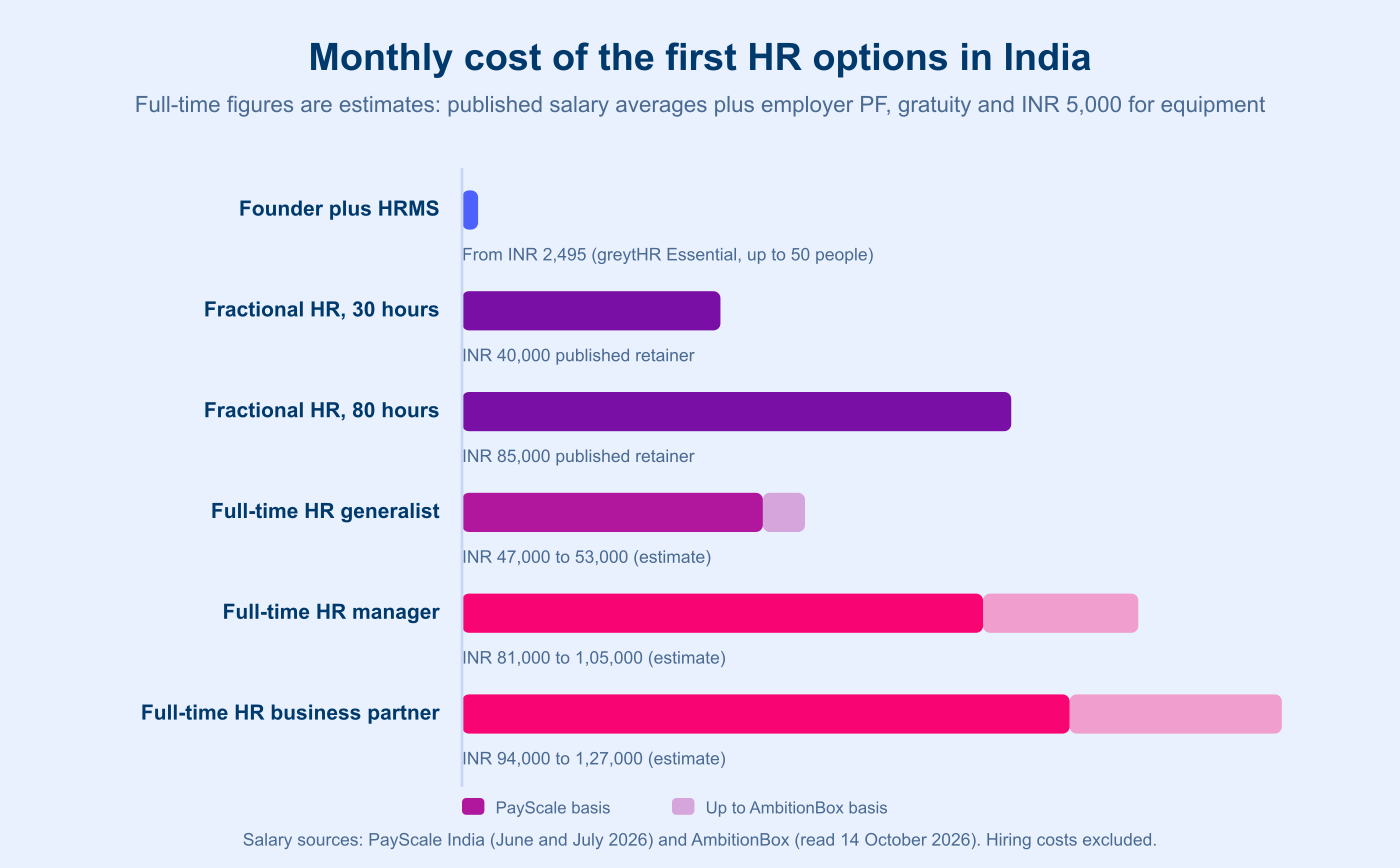
| Option | Monthly cost to the company | One-time cost to start | Hours you get | Best fit |
|---|---|---|---|---|
| Founder with payroll software | Software fee only; published HRMS plans start at about INR 2,495 a month for up to 50 employees (greytHR Essential, read 14 October 2026) | Setup time; templates for letters and policies | Whatever the founder can spare | 1 to 9 employees |
| Fractional HR manager | Published retainers from INR 40,000 a month for 30 hours to INR 85,000 for 80 hours | None to a small onboarding fee, depending on the provider | 30 to 80 contracted hours | 10 to 30 employees, or building the function before a full-time hire |
| Full-time HR generalist (estimate) | About INR 47,000 (PayScale basis) to INR 53,000 (AmbitionBox basis) | Six to twelve weeks of search and notice period; an agency fee if you use one | A full working month | 30 to 60 employees with a system already in place |
| Full-time HR manager (estimate) | About INR 81,000 (PayScale basis) to INR 1,05,000 (AmbitionBox basis) | As above, with a longer search for senior candidates | A full working month | 40 to 100 employees with no HR system yet |
| Full-time HR business partner (estimate) | About INR 94,000 (PayScale basis) to INR 1,27,000 (AmbitionBox basis) | As above | A full working month | 60 employees and above, with managers who need support |
Three points decide most of these choices.
Compare cost against the hours you need. A 20-person company has an estimated 35 to 60 hours of HR work a month. A full-time generalist at INR 47,000 to INR 53,000 is affordable at that size but under-used, and often too junior for the hard cases. A fractional manager at a similar monthly fee brings more experience for the hours that matter.
The full-time cost rises with the new EPFO ceiling. Where the basic wage sits between INR 15,000 and INR 25,000, employer provident fund is now mandatory on the higher amount. For a generalist that is most of the PF line in the table.
The start date differs by months. A full-time hire takes an estimated six to twelve weeks to arrive. If a threshold or a fundraise is due sooner, start with part-time help and hire behind it.
The compliance thresholds you will cross on the way
For reference, these are the central thresholds that most often decide timing for a startup with one office. State rules add to them. Our HR compliance checklist for India lists the full set by headcount and by month.
From the first employee: an appointment letter for every worker under the labour codes, in force since 21 November 2025, with central rules notified on 8 May 2026; state Shops and Establishments registration; professional tax where levied.
From ten employees: a POSH Internal Committee under the Sexual Harassment of Women at Workplace Act, 2013, with a fine of up to INR 50,000 for not constituting one; mandatory ESI coverage for employees earning up to INR 21,000 a month.
From twenty employees: provident fund under the Code on Social Security, now mandatory for employees with wages up to INR 25,000 a month from 17 September 2026; a Grievance Redressal Committee where the establishment has twenty or more workers, under the Industrial Relations Code.
From three hundred workers: certified standing orders, or adoption of the model standing orders, under the Industrial Relations Code.
Mistakes founders make when timing the first HR hire
Hiring a junior HR executive to save money. A first HR hire with one or two years of experience can run the calendar but cannot set it up or handle a contested exit. Pair a junior hire with senior part-time support.
Waiting for the full-time hire to fix compliance. The PF and POSH obligations start on the day you cross the threshold. A hire that joins three months later inherits three months of gaps.
Hiring a senior HR leader too early. A head of HR at thirty employees often has no team to lead and no strategy work to fill the month. Hire for the next eighteen months of work, not the next five years.
How unHR fits the first-HR decision
We place a certified HR manager with your company as its HR business partner for a fixed number of hours a month. Our managers handle pre-joining formalities, onboarding, engagement, appraisals, exit formalities and policy review, write HR policies and procedures, handle employee relations including sensitive matters, and implement an HRMS. Our monthly plan has no long-term commitment, so you can keep it until your own HR hire is in place. We have served more than 300 startups, have more than 30 certified HR managers, and work only with businesses under 500 employees.
Our plans are Early Stage at INR 40,000 a month for 30 hours for teams under 15, Pre-Series at INR 60,000 for 50 hours for teams under 30, and Growth Stage at INR 85,000 for 80 hours, with yearly options that add two free months. Every plan includes pre-joining formalities, onboarding, engagement, appraisals, exit formalities and policy review; candidate sourcing is not included. See how our embedded HR business partner works, or tell us your headcount and hiring plan and we will suggest the plan that fits.
Frequently asked questions
When should a startup hire its first HR person in India?
Put a named, trained person in charge of HR by the tenth employee, when the POSH Internal Committee and ESI coverage become mandatory. That can be a part-time or fractional HR manager. Hire the first full-time HR professional when HR work fills most of a month, which for most startups is between thirty and sixty employees. Hire earlier if you are recruiting every week, have received a grievance or POSH complaint, are preparing to raise a round, or have employees in more than one state.
At what employee count does a startup need HR?
Indian law does not require an HR employee at any headcount, but it switches on HR obligations at ten employees (POSH Internal Committee, ESI) and at twenty (provident fund registration, and a Grievance Redressal Committee at twenty or more workers). From ten employees someone with HR training should own those obligations. Most startups move to a full-time HR hire between thirty and sixty employees.
Should my first HR hire be a generalist or an HR business partner?
Hire a generalist if the HR system already exists, with policies, an HRMS and a compliance calendar in place, and the need is day-to-day execution. Hire an HR manager or HR business partner if nothing is set up yet, if the company is past fifty employees, or if people problems now reach the founders. Many startups have a fractional HR manager build the system first and then hire a generalist to run it, which costs less than an early senior hire.
How much does a first HR hire cost a startup in India?
On published salary averages from PayScale and AmbitionBox, and adding employer provident fund, gratuity accrual and equipment, a full-time HR generalist costs an estimated INR 47,000 to INR 53,000 a month, an HR manager INR 81,000 to INR 1,05,000, and an HR business partner INR 94,000 to INR 1,27,000. These are estimates and exclude hiring costs. Fractional HR retainers start at about INR 40,000 a month for 30 hours.
Can HR software replace an HR person in a small startup?
Below about ten employees, payroll software with the founder supplying inputs is usually enough. Above that, software computes contributions and stores records but cannot constitute a POSH committee, run an inquiry, handle a difficult exit or keep track of rule changes. Software is a tool for whoever owns HR, not a substitute for that owner.
Do investors expect a startup to have HR before a funding round?
Investors do not usually require an HR employee, but their legal due diligence asks for the records an HR function produces: appointment letters, PF and ESI challans, POSH committee records, ESOP documents and details of any disputes. Missing records can delay the close or become conditions in the deal. Put HR ownership in place three to six months before you start the raise.
Sources
Press Information Bureau, Government Makes the Four Labour Codes effective, 21 November 2025: pib.gov.in
Press Information Bureau, Cabinet Approves Higher EPFO Wage Ceiling of Rs. 25,000, effective 17 September 2026: pib.gov.in
Employees' State Insurance Corporation, coverage and wage limit: esic.gov.in
Ministry of Labour and Employment, labour codes and central rules: labour.gov.in
Press Information Bureau, Welfare of organised and unorganised sectors (labour codes in force from 21.11.2025), 8 December 2025: pib.gov.in
The Sexual Harassment of Women at Workplace (Prevention, Prohibition and Redressal) Act, 2013: indiacode.nic.in
PayScale India salary pages for HR Generalist, HR Manager and HR Business Partner, updated June and July 2026: payscale.com
AmbitionBox salary pages for HR Generalist, HR Manager and HR Business Partner, read 14 October 2026: ambitionbox.com
unHR pricing and HR business partner pages: unhr.in