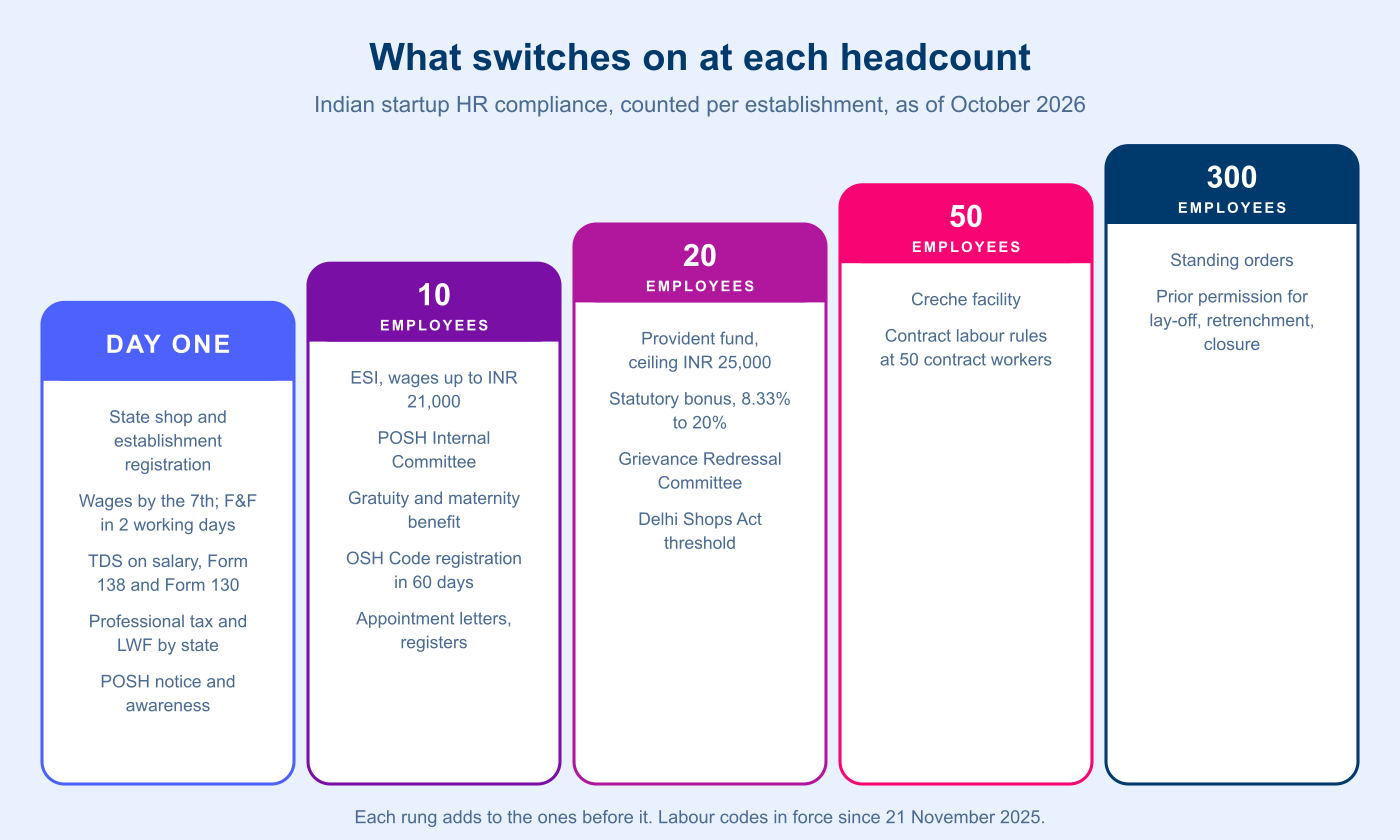
To stay compliant as a new business in India, register under your state's Shops and Establishments Act when you open, pay wages by the 7th of the following month, deduct TDS on salary and pay professional tax where your state levies it. Then add each obligation as headcount crosses its threshold: ESI, a POSH Internal Committee, gratuity, maternity benefit and OSH Code registration at 10 employees; provident fund, statutory bonus and a Grievance Redressal Committee at 20; a creche at 50; standing orders at 300. India's four labour codes have been in force since 21 November 2025, and the provident fund wage ceiling rose to INR 25,000 a month from 17 September 2026, so checklists written before those dates are out of date.
How to use this checklist
Indian labour law switches on by headcount, and each obligation starts on the day you hire the tenth or twentieth person, not at the end of the financial year.
Three counting rules decide what applies to you.
Count per establishment. The codes apply thresholds to an establishment, which in practice means each office or site. A company with 14 people in Bengaluru and 8 in Pune has two establishments, each assessed on its own count.
Count anyone employed in the last twelve months. Most thresholds read "employed, or were employed, on any day of the preceding twelve months". Dropping from 21 people to 19 does not switch provident fund off.
Know whether the rule counts employees or workers. The Code on Social Security counts employees. The Industrial Relations Code and the Occupational Safety, Health and Working Conditions Code (the OSH Code) count workers, a narrower term that excludes people in managerial or administrative roles and supervisors earning above INR 18,000 a month. A software startup can have 25 employees and fewer than 20 workers. When in doubt, comply at the lower count.
The central government makes the codes; states make their own rules under them and notify those rules on their own timelines. Professional tax, the Labour Welfare Fund and the Shops and Establishments Acts are state laws. This checklist gives the central position and flags each point where your state decides.
The headcount ladder at a glance
The table sets out each threshold, the law behind it and the figure you need. Each rung adds to the ones below it.
| Headcount | What switches on | Law and section | Numbers to know | What you keep or file |
|---|---|---|---|---|
| Day one (first employee) | Shop and establishment registration, minimum wages and timely payment, TDS on salary, professional tax and Labour Welfare Fund where the state levies them, POSH awareness | State Shops and Establishments Act; Code on Wages, 2019, ss. 5, 16 and 17; Income-tax Act, 2025, s. 392; Article 276 of the Constitution; POSH Act, 2013, s. 19 | Wages by the 7th of the next month; final dues within 2 working days of exit; professional tax capped at INR 2,500 a year per person | State registration certificate, wage register and wage slips, quarterly Form 138, annual Form 130 for each employee |
| 10 employees | ESI, POSH Internal Committee, gratuity, maternity benefit, OSH Code registration, appointment letters, annual leave and registers | Code on Social Security, 2020, First Schedule and ss. 53, 60 and 67; POSH Act, ss. 4 and 6; OSH Code, 2020, ss. 3, 6, 32 and 33 | ESI for wages up to INR 21,000 a month at 3.25 percent employer and 0.75 percent employee; 26 weeks' maternity benefit; POSH fine up to INR 50,000; registration within 60 days | ESI contributions within 15 days of month end, POSH committee order and annual report, OSH registration certificate, registers and returns |
| 20 employees | Provident fund, statutory bonus, Grievance Redressal Committee | Code on Social Security, First Schedule; Code on Wages, ss. 26, 39 and 41; Industrial Relations Code, 2020, s. 4 | 12 percent PF on wages up to INR 25,000 a month; bonus of 8.33 to 20 percent of wages, paid within 8 months of year end; committee of up to 10 members | EPFO registration, monthly ECR and payment by the 15th, bonus register, committee constitution order |
| 50 employees | Creche facility; contract labour rules once 50 or more contract workers are engaged | Code on Social Security, s. 67; OSH Code, s. 45 | Four creche visits a day for a mother; 50 contract workers on any day in the last 12 months | Creche arrangement, own or shared; contractor licence check |
| 300 workers | Standing orders; government permission before lay-off, retrenchment or closure | Industrial Relations Code, ss. 28 and 77 to 80 | Three months' notice for retrenchment of a worker with one year's service | Certified standing orders or the Model Standing Orders, 2026 |
Day one: what applies from your first employee
None of the following waits for a headcount.
Shops and Establishments registration. Every state has its own Act, its own threshold and its own portal. Register or file the intimation your state requires when the office opens, and again for each new office in another state. Thresholds are moving: Delhi amended its Act in 2026 so that it covers shops and establishments employing 20 or more employees. Check your own state's current rule before you assume you are exempt.
Minimum wages and payment of wages. Under the Code on Wages, every employee is entitled to at least the minimum wage, which until the codes applied only to scheduled employments. The wage period cannot be longer than a month (s. 16). Monthly wages must be paid before the 7th day of the following month, and an employee who resigns, is dismissed or is retrenched must be paid within two working days (s. 17). The code also requires wage slips and a wage register (s. 50).
The 50 percent wage rule. When you design a salary structure, the code's definition of wages (s. 2(y)) caps the excluded allowances, such as house rent allowance, conveyance and overtime, at one-half of total pay. Anything above that is added back into wages. Provident fund, gratuity and bonus are calculated on wages, so a structure with a 30 percent basic now pays those benefits on 50 percent.
TDS on salary. From 1 April 2026 the Income-tax Act, 2025 replaced the 1961 Act. Tax on salary is deducted under s. 392. The quarterly salary TDS statement is Form 138, which replaced Form 24Q, and the annual certificate to each employee is Form 130, which replaced Form 16. The process is the same; the numbers changed.
Professional tax. A state tax on employment, deducted from salary and paid by the employer. Article 276(2) of the Constitution caps it at INR 2,500 per person per year. Karnataka, Maharashtra and Telangana levy it; Delhi, Haryana and Uttar Pradesh do not. Register as an employer in each state that levies it.
Labour Welfare Fund. A state contribution with state-set amounts, thresholds and dates; some states have none. Check each state you operate in.
POSH awareness. The Sexual Harassment of Women at Workplace Act, 2013 stays a standalone law; the labour codes did not absorb it. Under s. 19 every employer must display the penal consequences of sexual harassment at the workplace and run awareness programmes. Below ten workers, complaints go to the Local Committee in your district (s. 6), so your policy should name it.
Appointment letters. The OSH Code (s. 6(1)(f)) makes a letter of appointment a legal duty for establishments covered by that code, and the government's own summary describes appointment letters as mandatory for all workers. Issue one from the first hire. It should state the designation, wages and the social security the person is entitled to.
Provident fund and ESI are voluntary below their thresholds. Some startups register early so that the first hires are covered from the start and the switch at 10 and 20 is a formality.
At 10 employees
At ten, five obligations arrive at once.
ESI. The Code on Social Security applies the ESI chapter to every establishment with ten or more persons. Employees earning up to INR 21,000 a month are covered (INR 25,000 for persons with disability). The employer pays 3.25 percent of wages and the employee 0.75 percent, and the contribution is due within 15 days of the end of the month. ESI replaces employee's compensation for covered staff.
POSH Internal Committee. Every workplace with ten or more workers must constitute an Internal Committee by written order (s. 4, read with s. 6). The presiding officer is a senior woman employee; at least two members are employees; one member comes from an NGO or is familiar with sexual harassment issues; at least half the members are women. The committee files an annual report each calendar year to the employer and the District Officer (s. 21). Failing to constitute it carries a fine of up to INR 50,000 (s. 26). If you have offices in two cities, each needs its own committee.
Gratuity. Applies to shops and establishments with ten or more employees. An employee who leaves after five years of continuous service is owed 15 days' wages for each completed year, calculated as monthly wages divided by 26 and multiplied by 15 (s. 53). Fixed-term employees are paid pro rata and do not need five years; the government's notification summary puts their eligibility at one year of continuous service. Provide for it in your books from the first year.
Maternity benefit. The Maternity Benefit Act, 1961 now sits inside the Code on Social Security and applies at ten employees. A woman who has worked 80 days in the twelve months before her expected delivery is entitled to 26 weeks of paid leave, no more than eight of them before delivery; 12 weeks if she already has two or more surviving children (s. 60).
OSH Code registration and duties. The OSH Code defines an establishment as a place where ten or more workers are employed. A new establishment must apply for registration electronically within 60 days of the code applying to it (s. 3). The same code requires registers of attendance, hours, wages and leave, notices on display, wage slips and returns to the inspector (s. 33). Workers who have worked 180 days in a calendar year earn one day of paid annual leave for every 20 days worked (s. 32); your state's Shops and Establishments Act may set its own leave rules as well. The government has also announced a free annual health check-up for workers above 40.
At 20 employees
Provident fund. Every establishment with 20 or more employees must register with EPFO. This is wider than before the codes, when only listed industries were covered. The employee contributes 12 percent of wages and the employer about 13 percent: 12 percent split between the EPF and the pension scheme, plus 0.5 percent for EDLI insurance and 0.5 percent administration charges. The statutory wage ceiling rose from INR 15,000 to INR 25,000 a month from 17 September 2026, the first change since 2014, so the maximum mandatory employer outgo per employee went from about INR 1,950 to about INR 3,250 a month. File the electronic challan cum return and pay by the 15th of the following month.
Statutory bonus. The bonus chapter of the Code on Wages applies to establishments with 20 or more persons (s. 41). Eligible employees who worked at least 30 days in the year get a minimum bonus of 8.33 percent of wages or INR 100, whichever is higher, and up to 20 percent where there is allocable surplus (s. 26). It must be paid within eight months of the close of the accounting year (s. 39), which for a March year end means by 30 November. The wage ceiling for eligibility and the base for calculation are set by notification. For establishments under the central government, notifications of 25 August 2026 set eligibility at wages up to INR 21,000 a month and calculation on INR 7,000 or the minimum wage, whichever is higher. States are notifying their own.
Grievance Redressal Committee. Every industrial establishment with 20 or more workers must have one (Industrial Relations Code, s. 4). Employer and worker representatives sit in equal numbers, the committee has no more than ten members, and women are represented in proportion to the workforce. A worker can raise a grievance within one year of the cause, and the committee may complete proceedings within 30 days. Our guide to handling employee grievances without an HR team covers how to set it up and run it.
At 50 employees and 50 contract workers
Creche. Every establishment with 50 or more employees must provide a creche within the prescribed distance, alone or shared with other establishments, and allow a mother four visits a day (Code on Social Security, s. 67). The code allows a common creche run by a government body, a private provider or a group of establishments, which suits offices in a shared building.
Contract labour. The contract labour part of the OSH Code applies to an establishment where 50 or more contract workers were engaged on any day of the past twelve months, and to manpower contractors with 50 or more (s. 45). If you use a facilities, security or staffing vendor at this scale, check that the contractor holds a licence under the code.
At 300 workers
Standing orders apply to industrial establishments with 300 or more workers (Industrial Relations Code, s. 28); the central government notified Model Standing Orders on 8 May 2026. At the same count, lay-off, retrenchment and closure need prior government permission, and retrenching a worker with one year's service needs three months' notice (ss. 77 to 80). Below 300, retrenching a worker with one year's continuous service needs one month's notice or pay in lieu and compensation of 15 days' average pay for each completed year (s. 70), plus 15 days' wages to the worker re-skilling fund (s. 83).
The checklist: what to do, in order
Work through these steps at incorporation, then repeat the threshold steps each time headcount at an office crosses 10, 20 and 50.
Register the office under your state's Shops and Establishments Act
Find your state labour department's portal, check whether your headcount needs a registration or an intimation, and file it when the office opens. Keep the certificate with your incorporation documents. Repeat for each office in a new state, and add professional tax and Labour Welfare Fund registration where that state levies them.
Fix the salary structure and the offer letter before the first hire
Set basic pay and dearness allowance at no less than half of total remuneration so the 50 percent rule does not reclassify pay later. Build the appointment letter template with designation, wages, wage period and social security entitlements. Decide your pay date so wages land before the 7th.
Set up payroll for TDS, professional tax and wage slips
Configure deduction under s. 392 of the Income-tax Act, 2025, the quarterly Form 138 and the annual Form 130. Check that your payroll tool has moved to the 2026 form numbers. Generate a wage slip for every employee every month and keep the wage register. Our comparison of payroll software and an HRMS helps with the tool choice.
Write the POSH policy and display it
Publish a policy that names the Local Committee for your district while you have fewer than ten workers, display the penal consequences in the office, and run an awareness session. When you reach ten, constitute the Internal Committee by written order, appoint the external member and train the committee.
At 10, register for ESI and under the OSH Code
Register the establishment with ESIC, enrol every employee earning up to INR 21,000 a month and pay contributions within 15 days of month end. Apply for OSH Code registration within 60 days. Start provisioning for gratuity and put the maternity benefit and leave rules into the leave policy.
At 20, register with EPFO and set up the bonus and grievance machinery
Register with EPFO, generate UANs, and file the monthly return and payment by the 15th on wages up to INR 25,000. Budget statutory bonus for eligible employees and pay it within eight months of year end. Constitute the Grievance Redressal Committee and tell employees how to reach it.
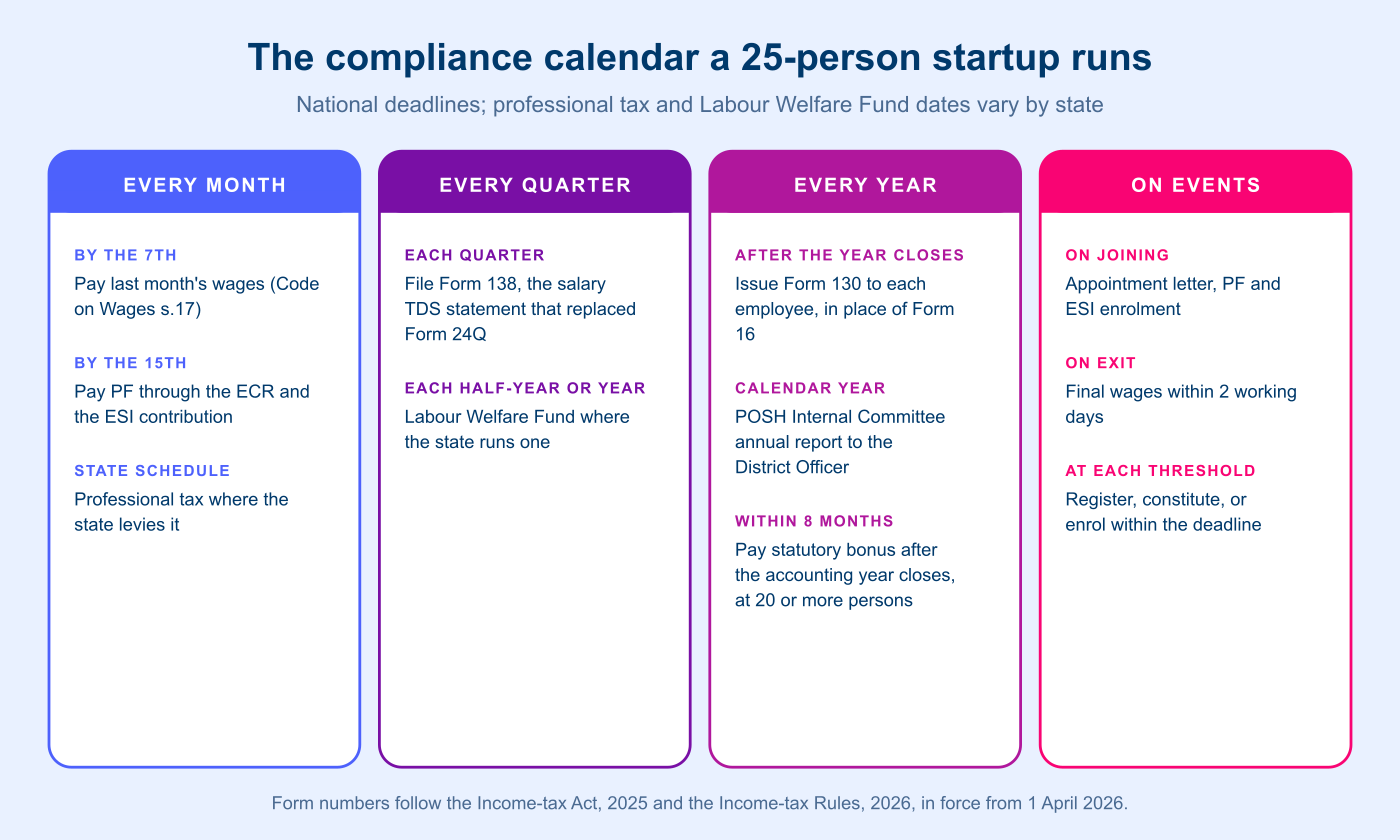
Keep one compliance calendar and one document folder
Put every monthly, quarterly and annual date in one calendar with a named owner, and keep registrations, committee orders, registers and returns in one folder. That folder is the first thing an investor asks for; our HR due diligence checklist for fundraising lists what they check.
Mistakes founders make with HR compliance
Counting the company, not the office. Most thresholds apply per establishment, but registrations follow the state. A second office in a new state means a second Shops Act registration, and possibly professional tax and Labour Welfare Fund where the first state had none. Our Delhi NCR guide shows how three states around one city give three different answers.
Using a pre-2026 template. Offer letters with a 30 percent basic, payroll still filing Form 24Q, a provident fund ceiling of INR 15,000, policies that cite the Industrial Disputes Act or the Maternity Benefit Act as live law. Each one marks the file as unreviewed since November 2025.
Constituting the POSH committee on paper only. A committee without an external member, without training, or without the annual report does not meet s. 4 or s. 21.
Waiting for the first HR hire to fix it. The obligations at 10 and 20 run from the day you cross the line. If you are weighing when to hire your first HR professional, the compliance calendar does not wait for that decision.
How unHR runs this checklist for startups
We place a certified HR manager with your company as its HR business partner for a fixed number of hours a month. Your HR manager handles onboarding, attendance and leave, appraisals, grievance redressal and exits including full and final settlement, and keeps your policies aligned with labour regulations. We have served more than 300 startups with more than 30 certified HR managers, and we work only with companies under 500 employees.
Our Early Stage plan is INR 40,000 a month for teams under 15, with 30 hours of engagement; Pre-Series is INR 60,000 for teams under 30 with 50 hours, and Growth Stage is INR 85,000 with 80 hours, each with a yearly option that adds two free months. For more on how the model works, read our guide to fractional HR in India, or talk to the unHR team about where your company sits on the ladder.
Frequently asked questions
What HR registrations does a new startup in India need?
From the first employee: registration or intimation under your state's Shops and Establishments Act, and professional tax and Labour Welfare Fund registration where your state levies them. At ten employees: ESI, and registration under the OSH Code within 60 days if you have ten or more workers. At twenty employees: provident fund registration with EPFO. Each new office in another state needs its own state registrations.
At what headcount is PF mandatory in India?
Provident fund is mandatory for every establishment with 20 or more employees under the Code on Social Security, 2020, in force since 21 November 2025. Contributions are 12 percent from the employee and about 13 percent from the employer on wages up to INR 25,000 a month, the ceiling in force from 17 September 2026. Below 20, a startup can register voluntarily.
When does a startup need a POSH Internal Committee?
When a workplace has ten or more workers. The committee must be constituted by written order, led by a senior woman employee, include at least two employee members and one external member, and be at least half women. It files an annual report each calendar year. The fine for not constituting one is up to INR 50,000. Below ten workers, complaints go to the district's Local Committee.
What changed for startups under the labour codes?
The four labour codes took effect on 21 November 2025 and replaced 29 central laws. For startups the main changes are the 50 percent rule on wages, which raises the base for PF, gratuity and bonus; provident fund for every establishment with 20 or more employees; gratuity for fixed-term employees without the five-year wait; appointment letters; and a single registration for establishments with ten or more workers. Central rules followed on 8 May 2026, and states notify their own rules on their own timelines.
Is Form 16 still issued for salary TDS?
No. From 1 April 2026 the Income-tax Act, 2025 and the Income-tax Rules, 2026 apply. Salary TDS is deducted under s. 392, the employer files the quarterly Form 138 in place of Form 24Q, and issues Form 130 to each employee in place of Form 16. The substance of the process is the same.
Sources
Press Information Bureau, Government makes the four labour codes effective, 21 November 2025: pib.gov.in
The Code on Social Security, 2020, gazette text: labour.gov.in
The Industrial Relations Code, 2020, gazette text: labour.gov.in
The Code on Wages, 2019, Gazette of India, 8 August 2019: egazette.gov.in
The Occupational Safety, Health and Working Conditions Code, 2020, Act 37 of 2020: indiacode.nic.in
Prime Minister's Office, Cabinet approves EPFO wage ceiling of INR 25,000, 16 September 2026: pmindia.gov.in
Employees' Provident Fund Organisation, employer information booklet: epfindia.gov.in
Employees' State Insurance Corporation, contribution and coverage: esic.gov.in
The Sexual Harassment of Women at Workplace (Prevention, Prohibition and Redressal) Act, 2013: doe.gov.in
Income Tax Department, Form No. 130 and Form No. 138 under the Income-tax Rules, 2026: incometaxindia.gov.in
unHR pricing and HR business partner pages: unhr.in