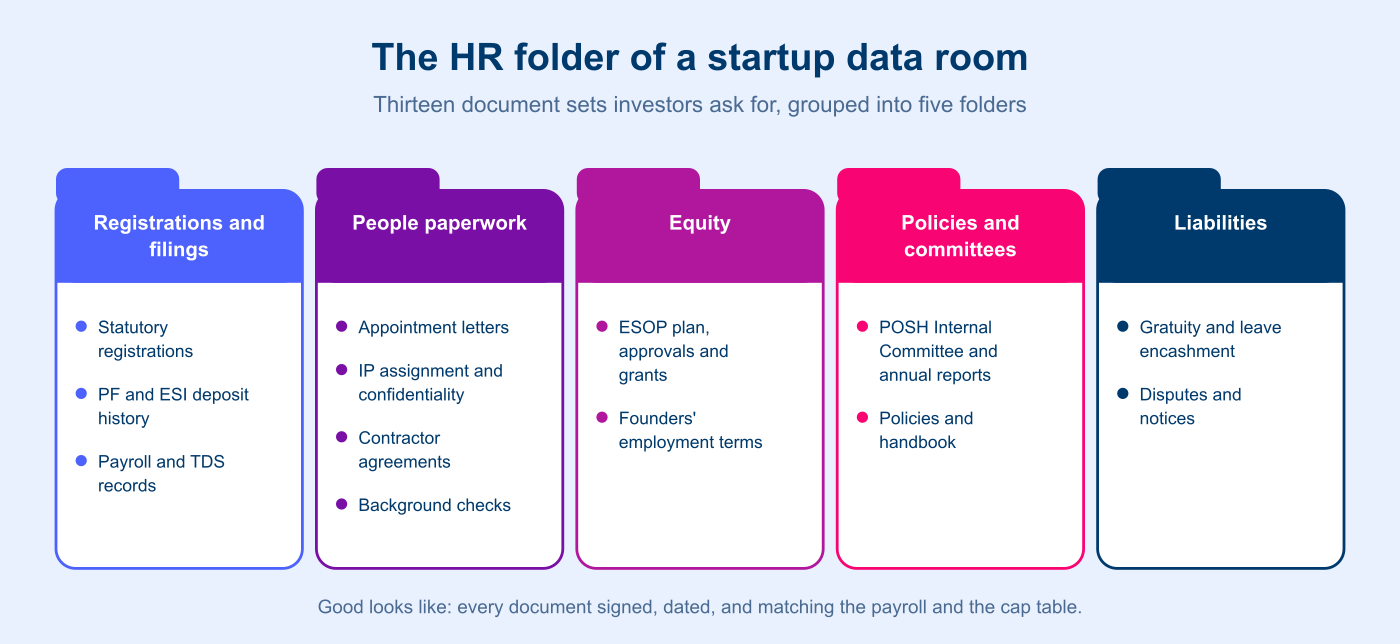
Before a seed, Series A or later round, investors' lawyers ask an Indian startup for proof of thirteen things on the people side: statutory registrations (PF, ESI, professional tax, Shops and Establishments), PF and ESI deposit history with any interest and damages paid, signed appointment letters, IP assignment and confidentiality clauses, the ESOP plan with board and shareholder approvals and every grant letter, contractor agreements, the POSH Internal Committee and its annual reports, policies and handbook, payroll and TDS records, gratuity and leave encashment liabilities, pending disputes, background checks for key hires, and the founders' own employment terms. Good looks like a data room where every document is signed, dated and matches the payroll and the cap table. The red flags are gaps between those three.
What HR due diligence is, and when it starts
Once a term sheet is signed, the lead investor appoints a law firm to run legal due diligence, and often an accounting firm to run financial and tax due diligence. Both send a request list, and the HR section is usually the one a young company is least ready for, because its documents were created one at a time, by different people, over two or three years.
Each finding in the due-diligence report becomes a condition precedent (fix it before the money comes in), a specific indemnity (the company or founders carry the cost later), or a disclosure against the warranties. A clean HR section shortens the time from term sheet to money in the bank.
The depth of the review grows with the round.
Seed. A questionnaire and document request checking that the basics exist: registrations, appointment letters with IP assignment, an approved ESOP plan, founders' agreements.
Series A. A full written report: PF and ESI history month by month, contractor classification, POSH, every ESOP grant against the pool, payroll and TDS reconciliation.
Series B and later. The same list across more people, states and years, plus gratuity and leave accounting and the move to the labour codes.
The HR data-room checklist
Use the table as the index of your data room's HR folder: each document set, what the lawyer checks, and the finding that most often becomes a condition or indemnity.
| Document | What investors check | Common red flag |
|---|---|---|
| Statutory registrations | PF, ESI, professional tax, Shops and Establishments and Labour Welfare Fund registrations for every office, dated against headcount | PF registration obtained months after the company crossed 20 employees; a second office in another state with no registration of its own |
| PF and ESI deposit history | Two to three years of monthly challans and returns matched to payroll, with any interest and damages | Late deposits, employees missing from returns, allowances structured to keep PF wages low |
| Appointment letters and employment contracts | A signed letter for every employee, with pay and notice terms matching payroll | Offer letters accepted by email with no signed appointment letter; pay in the letter different from pay in the payroll |
| IP assignment and confidentiality | Assignment of code, designs and content to the company, and confidentiality, signed by every employee, contractor and founder | Early engineers or freelance designers with no assignment on file; founders whose pre-incorporation work was never assigned to the company |
| ESOP plan and grants | Scheme, board and shareholder approvals, pool in the cap table, grant letters, vesting, option register | Options promised but never granted; grants beyond the pool; vesting under one year; ineligible founder grants |
| Contractors and consultants | Agreements, actual work, tenure, payment and TDS on invoices | Full-time people on monthly invoices for years, fixed hours under a manager, no PF |
| POSH Internal Committee | Constitution order, members including the external member, policy, training, annual reports | A committee named on a poster with no constitution order, no external member and no annual report filed |
| Policies and handbook | Current, dated policies with employee acknowledgements | A handbook copied from another company that still cites repealed Acts, or policies nobody has acknowledged |
| Payroll and TDS records | Payroll registers, TDS deposits, quarterly statements and annual certificates, reconciled to the books | TDS deducted but deposited late, statements not filed, or salary paid in cash or through a founder's account |
| Gratuity and leave encashment | Provision in the accounts and accrued encashable leave | No provision at all in the books; a leave policy that lets unlimited leave accumulate and be paid out on exit |
| Disputes and notices | Legal notices, inspections, POSH complaints, unpaid settlements | An open complaint the founders did not disclose, or a demand letter from EPFO sitting unanswered |
| Background checks for key hires | Identity, education and employment checks for leaders and anyone handling money or data | A senior hire whose stated degree or previous role cannot be confirmed |
| Founders' employment terms | Signed employment agreements, IP assignment, restrictive terms, any founder ESOPs | Founders with no agreement at all, or founders drawing pay as consultants from their own consultancy firms |
Statutory registrations and filings
The investor's question is simple: did the company register for each scheme when its headcount crossed the threshold, and has it filed every month since?
The thresholds changed when India's four labour codes came into force on 21 November 2025. The central rules under the codes were notified on 8 May 2026. Under the Code on Social Security, 2020, the thresholds that matter to a startup are:
Provident fund: every establishment with 20 or more employees. Before the codes, PF applied only to scheduled industries; it now applies to every establishment at 20.
ESI: every establishment with 10 or more persons. Employees earning up to INR 21,000 a month are covered (INR 25,000 for employees with disabilities).
Gratuity: every shop or establishment with 10 or more employees on any day of the preceding twelve months.
Two other registrations are state matters. Shops and Establishments registration is under each state's own Act, so a company with offices in two states needs two registrations. Professional tax is levied by some states, such as Karnataka and Maharashtra, and not by others, such as Delhi, Haryana and Uttar Pradesh. Our guide to HR consultants for startups in Delhi NCR works through how three states in one city region give three different answers.
The provident fund wage ceiling also moved this year. The Ministry of Labour and Employment notified INR 25,000 a month as the wage ceiling for provident fund, with effect from 17 September 2026 (S.O. 5109(E)), up from INR 15,000. An investor reviewing a round in late 2026 will check that payroll reflects it.
What good looks like: a one-page register of each registration, its number, date obtained, headcount on that date and state covered. Our HR compliance checklist for India sets out the calendar behind each one.
PF and ESI deposit history, interest and damages
A late deposit is a liability that follows the company into the new round, and investors also look for employees who were on payroll but never on the PF return. The cost of a late deposit has two parts.
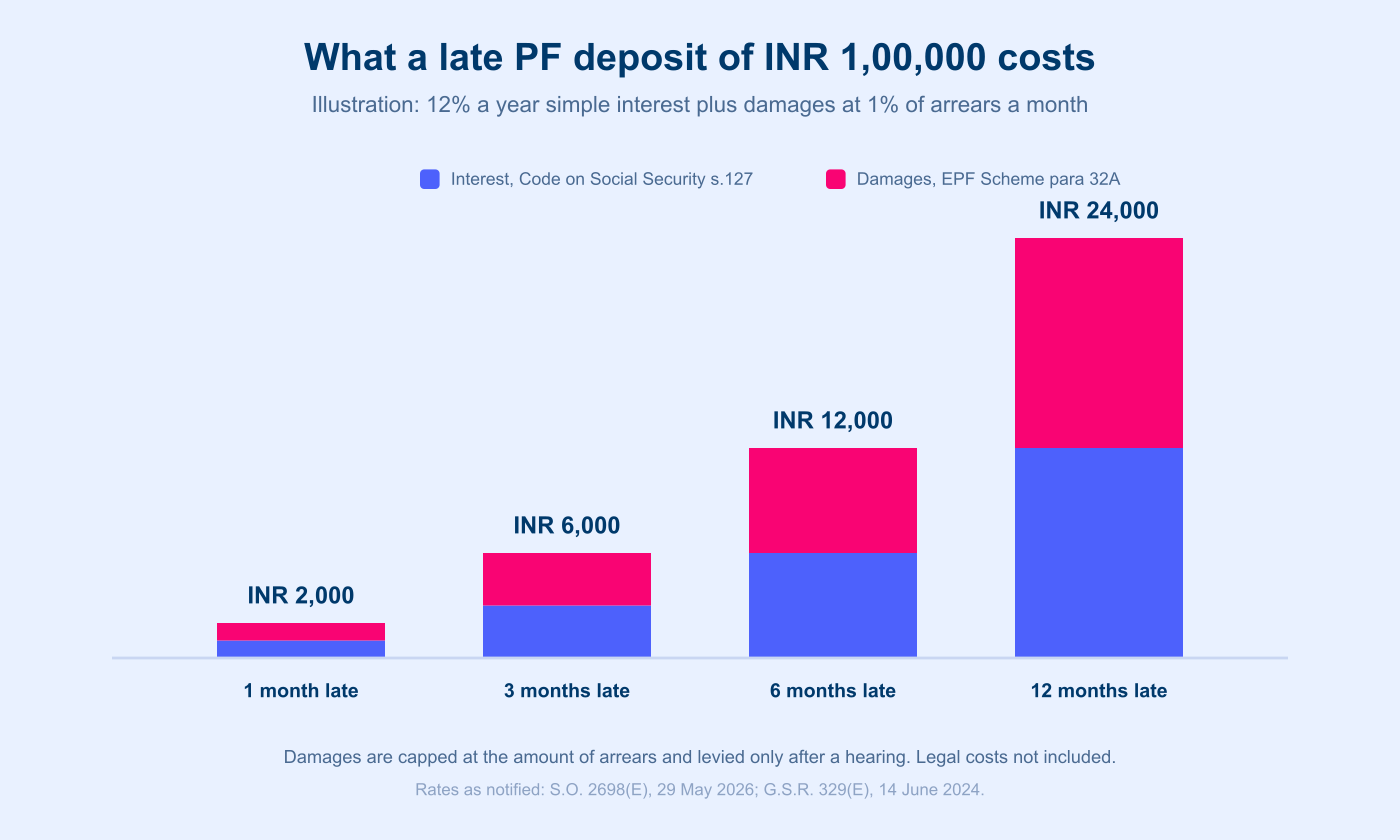
Interest. For periods up to 21 November 2025 it arose under section 7Q of the Employees' Provident Funds and Miscellaneous Provisions Act, 1952. Since then it arises under section 127 of the Code on Social Security. On 29 May 2026 the government notified the rate under section 127 at 12 percent a year simple interest on any amount due under the Code, from the due date to the date of payment, effective from 21 November 2025 (S.O. 2698(E)).
Damages. Section 14B of the EPF Act, and now section 128 of the Code, allow the PF authority to levy damages of up to the amount of the arrears, in the manner set by the scheme. Paragraph 32A of the EPF Scheme, as amended on 14 June 2024 (G.S.R. 329(E)), sets damages at one percent of the arrears for each month or part of a month of delay.
In plain numbers, a contribution of INR 1,00,000 deposited six months late costs about INR 6,000 in interest and up to INR 6,000 in damages, before any legal cost. That is an illustration, not an assessment; the authority must give the employer a hearing before levying damages.
What good looks like: a table for the last 24 to 36 months with due date, deposit date, amount, and headcount on the return against headcount on payroll, with a note on any interest and damages paid. A disclosed and paid gap is a footnote; an undisclosed one becomes an indemnity.
Appointment letters, IP assignment and confidentiality
These documents answer two questions: does the company employ the people it says it does, and does it own what they built. The lawyer compares each signed appointment letter with payroll and the company's notice policy. Offers accepted on email with no signed letter are the most common seed-stage finding.
The IP clause matters more. Investors look for a present assignment ("hereby assigns") of all inventions, code, designs and content created in the course of employment, a confidentiality obligation that survives exit, and the same clauses in contractor and consultant agreements. The gap that most often becomes a condition precedent is the early team: the freelancer who wrote the first version or the founder who built the prototype before incorporation. Each needs a signed assignment before closing.
What good looks like: one folder per employee with the signed letter, increment letters, IP and confidentiality agreement and policy acknowledgement, plus an index showing who is missing what.
ESOP plan, approvals and the pool in the cap table
Every ESOP finding is also a cap table finding. For a private company the rules sit in section 62(1)(b) of the Companies Act, 2013 and rule 12 of the Companies (Share Capital and Debentures) Rules, 2014. The points a lawyer checks:
Approval. The scheme must be approved by the board and by the shareholders by resolution before any option is granted, and the related filings with the Registrar must be on record. Your company secretary or lawyer confirms which resolution and filings apply; investors check it was done before the first grant.
Vesting. Rule 12 requires a minimum period of one year between the grant of options and vesting.
Who can receive options. Rule 12 excludes promoters, members of the promoter group, and directors who hold more than 10 percent of the equity, directly or through relatives or companies. A startup recognised under the government's startup definition is exempt from those exclusions for up to ten years from incorporation, following the amendment of 16 August 2019. Outside that window, founders cannot receive options.
The pool. The number of options in the approved scheme should match the pool shown in the cap table on a fully diluted basis, and options granted should never exceed it.
Tax on ESOPs moved to the Income-tax Act, 2025, which applies from 1 April 2026. Salary TDS, including tax on the ESOP perquisite, now sits in section 392 of that Act. An eligible startup under section 140 (the successor to the old section 80-IAC) can defer TDS on the ESOP perquisite to a later event, such as the employee selling the shares or leaving the company. Investors check the company holds the certification the deferral needs.
What good looks like: the scheme, approvals and filings, a signed grant letter for every grantee, and an option register that ties to the cap table. The most common red flag is an offer-letter promise of ESOPs that was never followed by a grant. Grant it or document why it lapsed, before the round.
Contractor or employee
Many Indian startups pay their first engineers, designers and sales staff as consultants on monthly invoices. Investors test each long-running contractor against how the person actually works: fixed hours, a reporting manager, company equipment, a company email address, exclusivity, and two years of monthly invoices for the same amount. A person who looks like an employee in every way except the paperwork is a potential claim for PF, gratuity and notice pay, and a possible TDS mismatch if tax was deducted at contractor rates instead of on salary.
What good looks like: a list of every contractor with agreement, scope, start date and payment terms, and a decision for each: a genuine contractor with a defined deliverable, or onto payroll with an appointment letter before the round.
POSH Internal Committee and annual report
The Sexual Harassment of Women at Workplace (Prevention, Prohibition and Redressal) Act, 2013 stands outside the labour codes and has not changed. Every employer must constitute an Internal Committee by written order; workplaces with fewer than ten workers are covered by the district's Local Committee instead. Under section 21 the committee prepares an annual report each calendar year and submits it to the employer and the District Officer. Under section 22 the employer includes the number of cases and their disposal in its own annual report, or tells the District Officer where no annual report is prepared. Under section 26 an employer who fails to constitute the committee, or breaches other provisions, can be fined up to INR 50,000, with higher penalties for a repeat offence.
What good looks like: a constitution order naming a senior woman as presiding officer, at least two employee members and one external member; the policy; training records; each year's annual report; and a confidential summary of complaints.
Policies and the handbook
Many startups adopted a handbook from a template that still refers to Acts the codes repealed. A lawyer notices. The minimum set investors expect: leave, code of conduct, grievance redressal, POSH, travel and expense, remote or hybrid work, IT and data protection, and exit. Each should be dated, current, and acknowledged by employees. Our guide to handling employee grievances without an HR team covers what a grievance policy should say and the committee that becomes mandatory at 20 workers.
Payroll and TDS records
Financial due diligence reconciles payroll to the books and tax filings. Since 1 April 2026 the Income-tax Act, 2025 applies, with new form numbers. TDS on salary is under section 392 (section 192 of the 1961 Act). The quarterly salary TDS statement is Form 138, earlier Form 24Q. The annual salary TDS certificate to employees is Form 130, earlier Form 16. For earlier years the investor will still ask for Forms 24Q and 16.
What good looks like: registers, challans, statements and certificates for every year, with salary cost in the accounts reconciled to the TDS statements. If the company runs payroll in spreadsheets, our comparison of payroll software and an HRMS explains which system leaves a cleaner audit trail.
Gratuity and leave encashment liabilities
Both are liabilities that grow quietly. Gratuity is payable on leaving after five years of continuous service, and fixed-term employees are paid gratuity on a pro rata basis. Under the Code on Wages, allowances beyond half of total remuneration count as wages, which raises the base on which gratuity is calculated for many startup pay structures. Leave encashment depends on the leave policy and the state Shops and Establishments law: if the policy lets leave accumulate without a cap and pays it out on exit, the company owes it.
What good looks like: a schedule of employees with joining dates and wages, a gratuity and leave provision in the latest accounts (often backed by an actuarial valuation), and a leave policy with a carry-forward cap and a stated encashment rule.
Disputes, background checks and the founders' own terms
Disputes. Expect a request for every legal notice, complaint, inspection report and demand from the last three years, including unpaid full and final settlements. Disclose them; an issue the investor finds on its own changes the conversation.
Background checks. Investors want evidence that the leadership team, and anyone handling money or customer data, were checked for identity, education and past employment. Run the checks with the candidate's consent and keep the reports on file.
Founders. Founders who work in the company need signed employment agreements covering role, pay, IP assignment, confidentiality and the restrictive terms investors will mirror in the shareholders' agreement. Founders billing through their own consultancy firms is a common Series A finding. Any founder ESOPs must sit inside the startup relaxation described above.
Fix it before the round: a six-step sequence
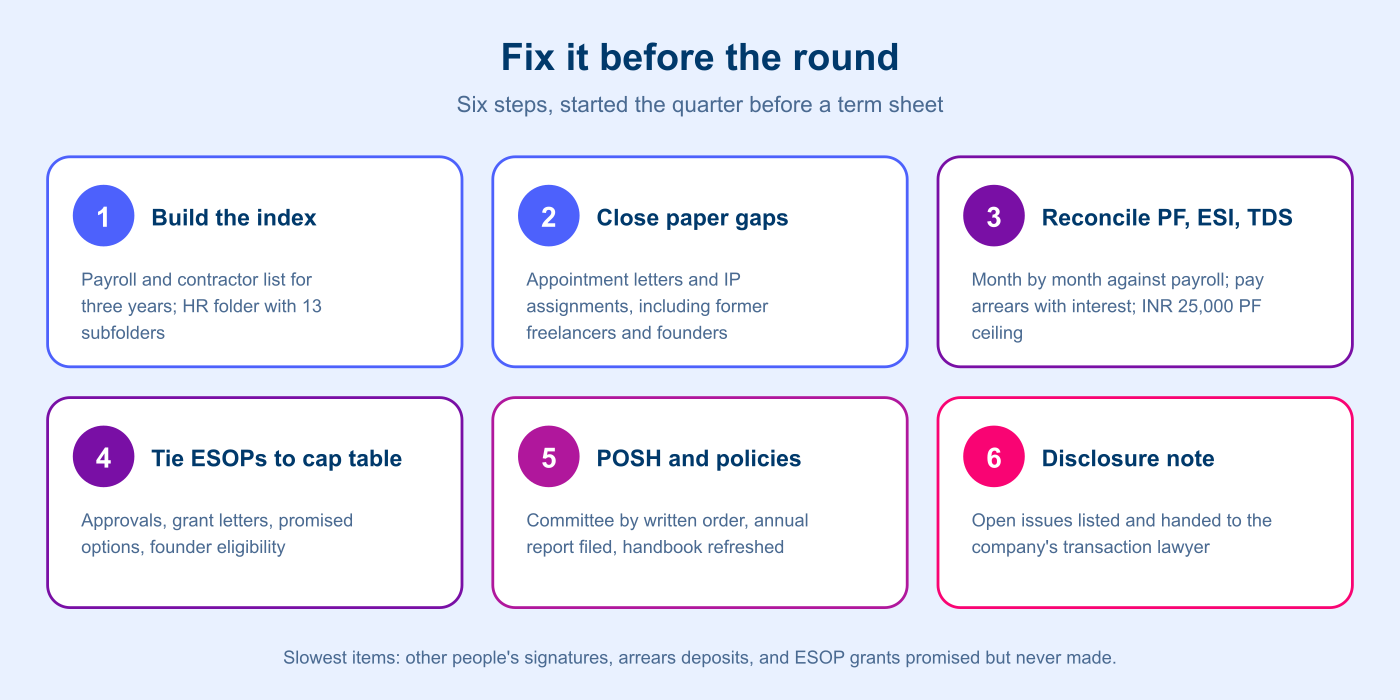
Start the quarter before you expect a term sheet. The slowest tasks are the ones that need other people's signatures.
Build the index and pull the payroll list
Export the current payroll and a list of everyone paid in the last three years, employees and contractors. Create the HR folder with the thirteen checklist rows as subfolders. Every later step checks documents against this list.
Close the paper gaps on people
For each person, check for a signed appointment letter or contractor agreement and a signed IP assignment and confidentiality agreement. Issue what is missing, including assignments from former freelancers and founders. Contact former contributors first; theirs are the hardest signatures to get.
Reconcile PF, ESI and TDS month by month
Match each month's PF and ESI return and TDS deposit against payroll. Deposit any arrears with interest, record the dates, and make sure the October 2026 payroll applies the INR 25,000 PF wage ceiling. Note each late month and what was paid for it.
Tie the ESOP register to the cap table
Collect the scheme, the board and shareholder approvals and the filings. List every option promised in an offer letter and every option granted, and reconcile both to the pool in the cap table. Grant what was promised, or record why it lapsed. Check founder grants against the startup relaxation and its ten-year window.
Constitute what is missing and refresh the policies
Constitute or reconstitute the POSH Internal Committee by written order with an external member, file the annual report that is due, and run the training. Replace references to repealed Acts in the handbook, add a leave carry-forward cap, and collect acknowledgements.
Write the disclosure note and brief your lawyer
List every open issue, such as late deposits paid, contractors moved to payroll or a pending complaint, and give it to the lawyer acting for the company in the transaction so disclosures and warranties match. This guide states the rules; the transaction needs that lawyer.
How an embedded HR manager from unHR prepares the HR folder
We place a certified HR manager with your company as its HR business partner for a contracted number of hours a month. Before a round, that person builds the folder this guide describes: letters and exit paperwork in order, policies reviewed against current law, and the onboarding and exit records lawyers ask for. We have served more than 300 startups, have a physical presence in seven cities, and work only with companies under 500 employees.
Our Early Stage plan is INR 40,000 a month for 30 hours, Pre-Series is INR 60,000 for 50 hours and Growth Stage is INR 85,000 for 80 hours, each with a yearly option that adds two free months. Every plan includes pre-joining formalities, onboarding, engagement, appraisals, exit formalities and policy review. DPIIT-recognised startups can use our Startup India programme. If you are weighing this against a first full-time hire, our guides to fractional HR in India and to hiring your first HR professional set out the trade-off.
Frequently asked questions
What HR documents do investors ask for during due diligence in India?
Registrations and PF and ESI filings, signed appointment letters, IP assignment and confidentiality agreements, the ESOP scheme with approvals and grant letters, contractor agreements, the POSH committee order and annual reports, policies, payroll and TDS records, gratuity and leave provisions, disputes, background checks for key hires, and founders' employment agreements.
When should a startup start preparing HR due diligence before fundraising?
Start about a quarter before you expect a term sheet. The slowest items are IP assignments from former freelancers and founders, PF or TDS arrears to deposit with interest, and ESOP grants promised but never made.
What happens if PF was deposited late or missed?
The employer owes the arrears plus simple interest at 12 percent a year from the due date to the date of payment, notified under section 127 of the Code on Social Security from 21 November 2025, and section 7Q of the EPF Act for earlier periods. The PF authority can also levy damages of up to the amount of the arrears; under paragraph 32A of the EPF Scheme the rate is one percent of the arrears per month of delay.
Can founders get ESOPs in an Indian private company?
Generally no. Rule 12 of the Companies (Share Capital and Debentures) Rules, 2014 excludes promoters, the promoter group and directors holding more than 10 percent of the equity from receiving options. A company that meets the government's startup definition is exempt from that exclusion for up to ten years from incorporation. Confirm eligibility with your company secretary or lawyer before any founder grant.
Do investors check whether contractors should be employees?
Yes. Lawyers look at long-running contractors who work fixed hours under a manager, use company equipment and email, and invoice the same amount every month. If they are employees in practice, the company may owe PF, gratuity and notice pay. The usual fix is moving them onto payroll before the round.
Is a POSH committee required for a startup raising funds?
A POSH Internal Committee is required for every workplace with ten or more workers, whether or not the company is raising money. The committee must be constituted by written order, include an external member, and file an annual report each calendar year under section 21 of the Act. The fine for not constituting it is up to INR 50,000. Investors ask for the order, the reports and a summary of any complaints.
Sources
The Code on Social Security, 2020, sections 53, 127, 128 and First Schedule, Ministry of Labour and Employment: labour.gov.in
Industrial Relations (Central) Rules, 2026, G.S.R. 342(E), 8 May 2026: labour.gov.in
S.O. 2698(E), 29 May 2026, interest at 12 percent under section 127 of the Code on Social Security: egazette.gov.in
Prime Minister's Office, Cabinet approves enhancement of EPFO wage ceiling from Rs.15,000 to Rs.25,000 per month, 16 September 2026: pmindia.gov.in
Employees' Provident Fund Organisation: epfindia.gov.in
Employees' State Insurance Corporation, coverage: esic.gov.in
The Sexual Harassment of Women at Workplace (Prevention, Prohibition and Redressal) Act, 2013, sections 4, 6, 21, 22 and 26: doe.gov.in
Companies Act, 2013, section 62, and Companies (Share Capital and Debentures) Rules, 2014, rule 12: mca.gov.in
Income-tax Act, 2025, section 392, and Form No. 138 (earlier Form 24Q): incometaxindia.gov.in
unHR pricing and HR business partner pages: unhr.in
Raising in the next two quarters? Talk to the unHR team about putting an HR manager on your data-room folder before the term sheet arrives.